
There is a morning every winter, usually the first one that drops past minus 30 overnight, where our phone starts at about ten past seven and does not stop. It is always the same call. A diesel that ran fine yesterday cranks strongly, sounds healthy, and will not start. Or it starts, runs for two minutes, and dies. Nobody did anything wrong. The fuel just quietly turned into something the engine cannot pull through a filter.
That is gelling, and the frustrating part is that it is almost entirely preventable with decisions you make in October and November rather than on the morning it happens. If you want the fuel system checked and the filter fresh before the first hard snap, book it into our service department while it is still shoulder season. Here is what is actually happening in the tank, and the honest read on what helps.
Key Takeaways
- Diesel does not freeze, it waxes. Diesel fuel contains paraffin wax that stays dissolved when it is warm. As the fuel cools past its cloud point, that wax comes out of solution as tiny crystals, and the fuel goes hazy. Cool it further and those crystals link up until the fuel will not flow.
- The filter plugs before the tank does. The failure point is almost always the fuel filter, not a solid tank. Wax crystals collect on the filter media and choke off flow, which is why the classic symptom is a truck that starts and then dies rather than one that never fires.
- Canadian pumps already sell you winter fuel. Diesel in Canada is supplied seasonally against CAN/CGSB-3.517, and prairie winter diesel is typically blended to operate in the range of roughly minus 30 to minus 35 Celsius. You are not starting from summer fuel unless you are burning summer fuel you stored yourself.
- The single biggest gelling risk out here is old fuel in the tank, not the fuel at the pump. Fuel bought in September and still sitting in a half full tank in January is summer blend, and no additive fixes that as well as simply burning through it and refilling.
- Additives are real but they are not magic, and they are not free of rules. Cummins publishes its own list of recommended fuel additives and its own cold weather guidance, and the consistent advice across it is to ask whether the fuel is already treated before you add more. Doubling up on treated fuel is money spent for nothing.
What Gelling Actually Is
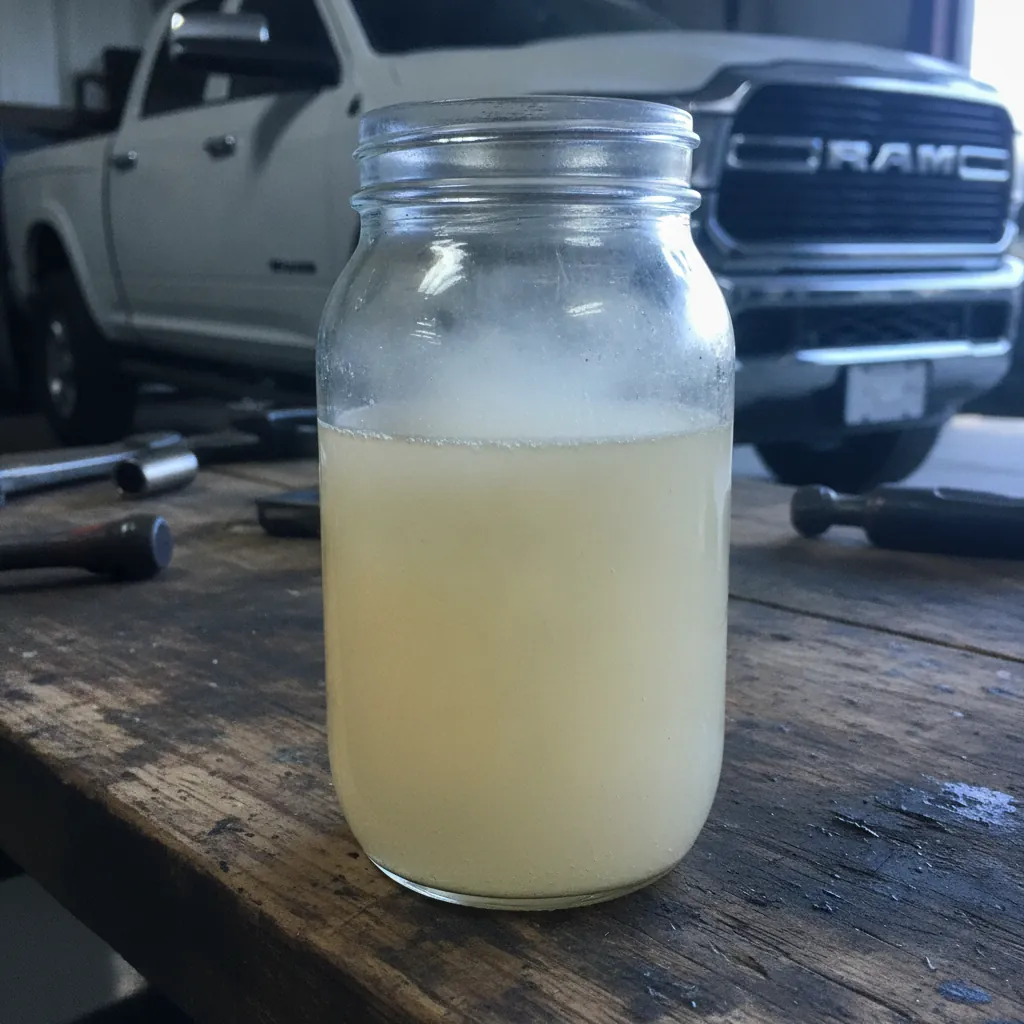
Diesel is not one substance. It is a blend of hydrocarbons, and some of them are paraffin wax. That wax is a feature, not a contaminant. It carries energy and it is part of why diesel has the energy density it does.

At normal temperatures the wax is fully dissolved and the fuel is clear. As the fuel cools it reaches its cloud point, the temperature at which wax crystals begin to form and the fuel visibly goes cloudy. Nothing has failed yet. The fuel still flows, and the engine will still run.
Keep cooling it and those crystals grow and start to interlock. The next threshold that matters is the cold filter plugging point, the temperature at which the crystals are large and numerous enough to blind a fuel filter. That is the number that decides whether your truck starts, because a fuel filter is a fine screen and wax is very good at covering one.
Cool it further still and you reach the point where the fuel behaves like a gel and will not pour at all. Most Manitoba owners never actually get there. They get stopped at the filter long before the tank turns solid, which is worth knowing because it changes what you do about it.

How the Fuel You Buy Here Is Already Different in Winter
This is the part most owners do not realize, and it is genuinely reassuring.
Canada does not sell one diesel year round. Diesel fuel quality here is specified under CAN/CGSB-3.517, which allows the low temperature operability of a fuel to be defined by cloud point or by low temperature flow testing, and several provinces reference that standard directly in their own fuel regulations. Suppliers then blend regionally and seasonally to hit the numbers their market needs.
In practice that means refineries and terminals lighten the fuel for winter, typically by blending in a lighter component such as kerosene or a No. 1 diesel fraction, and by adding cold flow improvers that control the size and shape of the wax crystals so they stay small enough to pass a filter. For the prairies, winter blended diesel is generally supplied to perform down into the range of roughly minus 30 to minus 35 Celsius, with milder regions and shoulder seasons targeting warmer numbers.
So the fuel going into your tank in January at a Portage or Winnipeg pump is not the fuel that went in during August. That is the good news.
Here is the catch, and it is the one that actually bites people out here. The blend protects the fuel you buy. It does nothing for the fuel already in the tank. Two situations account for most of the gelling we see:
The half full tank that has been sitting. A truck that gets used hard in the fall and then parks for a few weeks in December is running on whatever was cheapest in November. If that fuel went in during a mild stretch, its cold flow numbers may be nowhere near what the January weather demands.
Farm and bulk tank fuel. A yard tank filled in the fall is a snapshot of that day's blend, and it will still be that blend in February. This is the single most common source of a genuinely gelled truck in our part of the province, and it has nothing to do with the truck.
The Symptoms, In the Order They Show Up
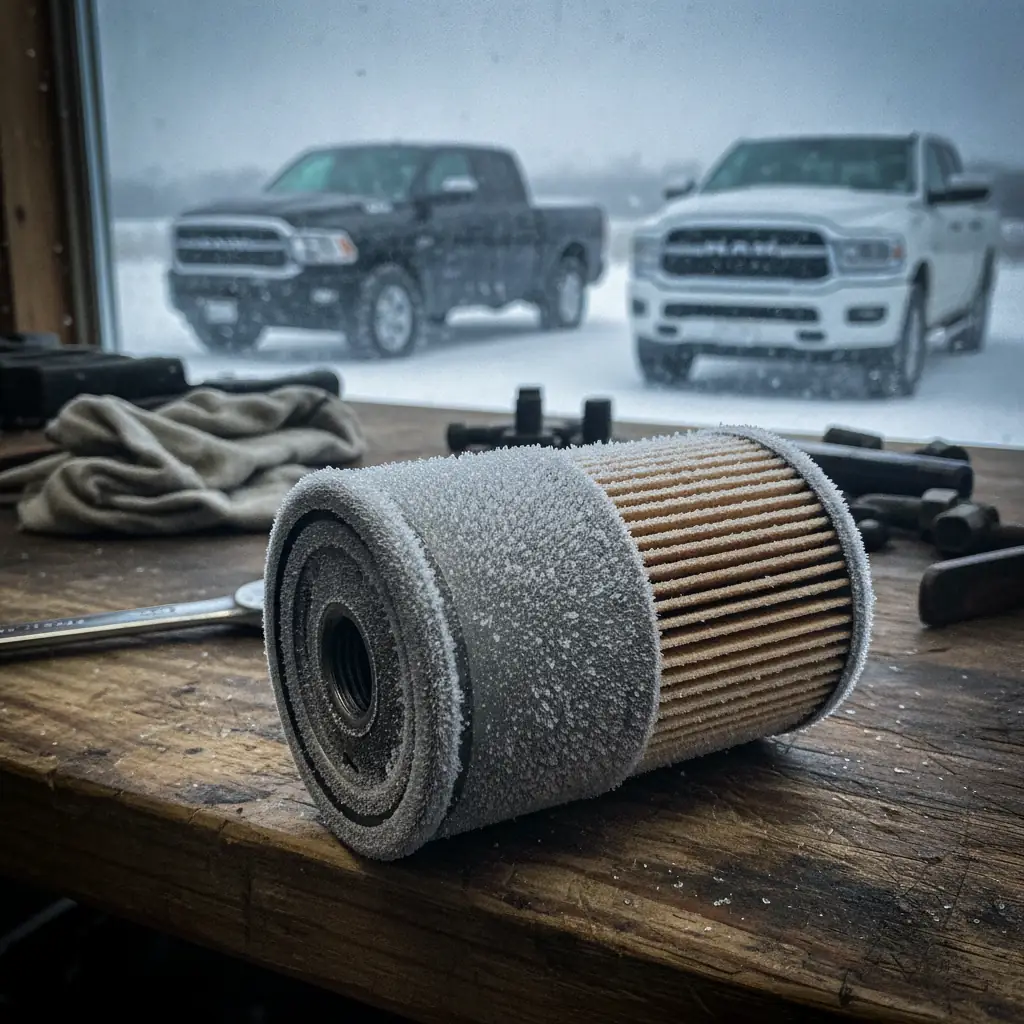
Gelling has a recognizable progression, and knowing it tells you how far along you are.
Hard starting on a cold morning that resolves once it runs. Early stage. Wax is forming but the filter is still passing enough fuel. Take this as a warning rather than a nuisance.
Starts, runs for a minute or two, then dies. This is the signature. The engine consumes the fuel already downstream of the filter, then starves. It is the most common way a gelled truck presents.
Loss of power under load, or a stumble that clears at low throttle. Partial restriction. The engine can get enough fuel to idle but not enough to make power.
Cranks strongly and never fires at all. Later stage, or a truck that sat outside all night after the fuel was already marginal.
A truck that gels on the road, not in the driveway. This one surprises people. Wind chill on a fuel line or a filter housing at highway speed pulls heat out of the fuel faster than a parked truck loses it. Getting somewhere fine and then dying twenty minutes later is a real pattern.
If you are already at the "runs and dies" stage, do not keep cranking it. Repeated cranking on a starved system is hard on the starter and the batteries, and you will need both once the truck is warm. Get it somewhere heated. Warmth reverses the process, because wax that came out of solution goes back into it. That is the one genuinely good thing about gelling: it is not permanent damage, it is a state.
The Honest Read on Anti Gel Additives
This is where most articles turn into a product ad, so here is the version we would give you across the parts counter.
Additives are real chemistry and they do work. Cold flow improvers change how wax crystals grow, keeping them small and separate rather than letting them link into a mesh, which is exactly what keeps a filter passing fuel. This is the same class of chemistry the refineries already use.
But your fuel may already be treated, and that matters. The consistent guidance from Cummins is to ask your fuel supplier whether the fuel already contains a winter additive before you buy more, because depending on what and how much is already in there, additional treatment may simply be unnecessary. Winter blended pump diesel in this province usually already carries cold flow improver. Pouring a second dose into an already treated tank does not double the protection, it mostly doubles the cost.
Follow the manual, not the shelf. Cummins names its own recommended fuel additives for cold weather service, and your owner's manual is the authority on what is approved for your engine. There is a lot of product on a parts shelf and not all of it belongs in a modern common rail system. We are not going to tell you which bottle to buy in a blog post, because the right answer depends on your engine and your fuel source. Bring the truck and the question to our parts department and we will match it to your VIN and your manual.
Dose it before it is cold, not after. This is the practical rule that actually matters. An anti gel additive is a preventative. It cannot dissolve wax that has already formed and plugged a filter. Once the filter is blinded, the fix is heat and a filter change, not a bottle. Treating fuel on the way into the tank is the only version that works.
The fuel choice underneath all of it. Cummins guidance is straightforward on grade: use a clean, fresh No. 2 diesel when ambient temperatures are above freezing, and a No. 1 diesel when they are below. In practice at a Canadian retail pump you are buying a seasonal blend rather than choosing a grade off a menu, but it is the principle behind why winter fuel is lighter.
What Actually Prevents It, Out Here
Five things, in the order they are worth your attention.
Keep the tank full through the winter, and keep the fuel turning over. A full tank of current season fuel is the strongest protection you have, and it has a second benefit: less air space in the tank means less condensation, and water in diesel is its own winter problem because water freezes where fuel only waxes. Half a tank of November fuel in January is the setup for the whole failure.
Change the fuel filter before winter, not during it. A filter with a season of use on it has less clean media left to give, so it plugs at a warmer temperature than a fresh one would. This is the highest value single item on the list and it is a scheduled maintenance item anyway. We laid out the intervals and what actually drives them in our post on Cummins fuel filter change intervals.
Know your fuel source. If you draw from a farm or yard tank, know when it was filled and with what. A bulk tank filled in October is October fuel forever. If that is your situation, treatment on filling is genuinely worth it, and it is the case where an additive earns its money most clearly.
Plug it in and park it out of the wind where you can. A block heater does not warm the fuel tank, but a warmer engine bay keeps the fuel lines, the filter housing and the fuel already in the system above the temperatures where wax matters. Parking out of a north wind does more than people expect.
Do not idle it all night as a strategy. It is expensive, it is hard on a modern diesel, and it is not the fix people think it is. We wrote the full version of that argument in our post on warming up a diesel in the cold.
None of these are exotic. They are the difference between a diesel that is a non issue all winter and a diesel that owns one of your mornings.
If It Has Already Gelled
Short version, because this is the emergency page.
Stop cranking. Get the truck somewhere warm, or get warmth to the truck. A heated shop is the fastest and safest route, and a tow into a bay costs less than a starter and a set of batteries. Never apply an open flame to a fuel system, and never use an unvented heater in a closed space. Once the truck has warmed through, the wax redissolves, but the filter that collected all of it usually needs to be replaced regardless, because it has been through the worst day of its life.
Then deal with the tank. If the fuel in it is out of season, the real fix is burning it down and refilling with current blend rather than trying to rescue it chemically.
If you are stuck on a cold morning and not sure what you are looking at, call us. Our service centre has done this every winter for a long time, and telling the difference on the phone between a gelled truck, a dead battery and a genuine no start is usually about three questions.
FAQs
At what temperature does diesel fuel start to gel?
There is no single number, because it depends entirely on the blend. What matters are two thresholds: the cloud point, where wax crystals first form and the fuel goes hazy, and the cold filter plugging point, where those crystals are enough to blind a fuel filter and stop the engine. Winter blended diesel supplied for the prairies is generally built to operate down into the range of roughly minus 30 to minus 35 Celsius, which is why untreated summer fuel left in a tank is a far bigger risk here than the fuel at the pump.
Is the diesel at Manitoba pumps already winterized?
Yes, in season. Canadian diesel is supplied seasonally and regionally against CAN/CGSB-3.517, and winter supply for this region is blended and additised for cold flow. The protection applies to the fuel you are buying now, not to fuel that has been sitting in your tank or a yard tank since the fall.
Do I still need an anti gel additive if I buy winter diesel?
Often not. Cummins guidance is to ask your fuel supplier whether the fuel already contains a winter additive before treating it, because additional additive may be unnecessary depending on what is already in the fuel. Where treatment clearly earns its place is with bulk or farm tank fuel of uncertain age, or a truck that will sit for weeks on fuel bought in a milder stretch.
Can I add an anti gel additive after my truck has already gelled?
No, not usefully. Cold flow improvers work by changing how wax crystals form. They cannot dissolve wax that has already come out of solution and plugged a filter. Once you are at that stage the answer is heat plus a fresh fuel filter, and the additive goes in on the next fill as prevention.
Why does my diesel start fine and then die a minute later in the cold?
That is the classic gelling signature. The engine burns the fuel already downstream of the filter, then starves because wax on the filter media is stopping the flow behind it. It is more common than a truck that never fires at all, and it is a strong signal to stop cranking and get it warm rather than keep trying.
Does keeping the tank full actually help?
Yes, for two separate reasons. A full tank means you are running current seasonal fuel rather than something bought months ago, and it leaves less air space for condensation. Water is a real winter diesel problem in its own right, because unlike the fuel it genuinely does freeze, and it collects in exactly the places you do not want ice.
The Bottom Line
Gelling is not a mystery and it is not bad luck. It is wax coming out of solution in fuel that was not blended for the temperature it ended up seeing, and the failure point is your fuel filter rather than your tank. The pumps here already do most of the work for you in season. What they cannot do is fix the fuel that was already in your tank, which is why the biggest risk out here is age, not temperature.
Full tank, fresh filter, know where your fuel came from, and treat it on the way in rather than after the fact. Do those four things in September and October and the first minus 30 morning is just a cold morning. If you want the fuel system gone through before the snap, book it in now, and if you are shopping a diesel to begin with, our new Ram 2500 inventory is online.
Tyler Dunn, Dunn Ram Trucks, Portage la Prairie