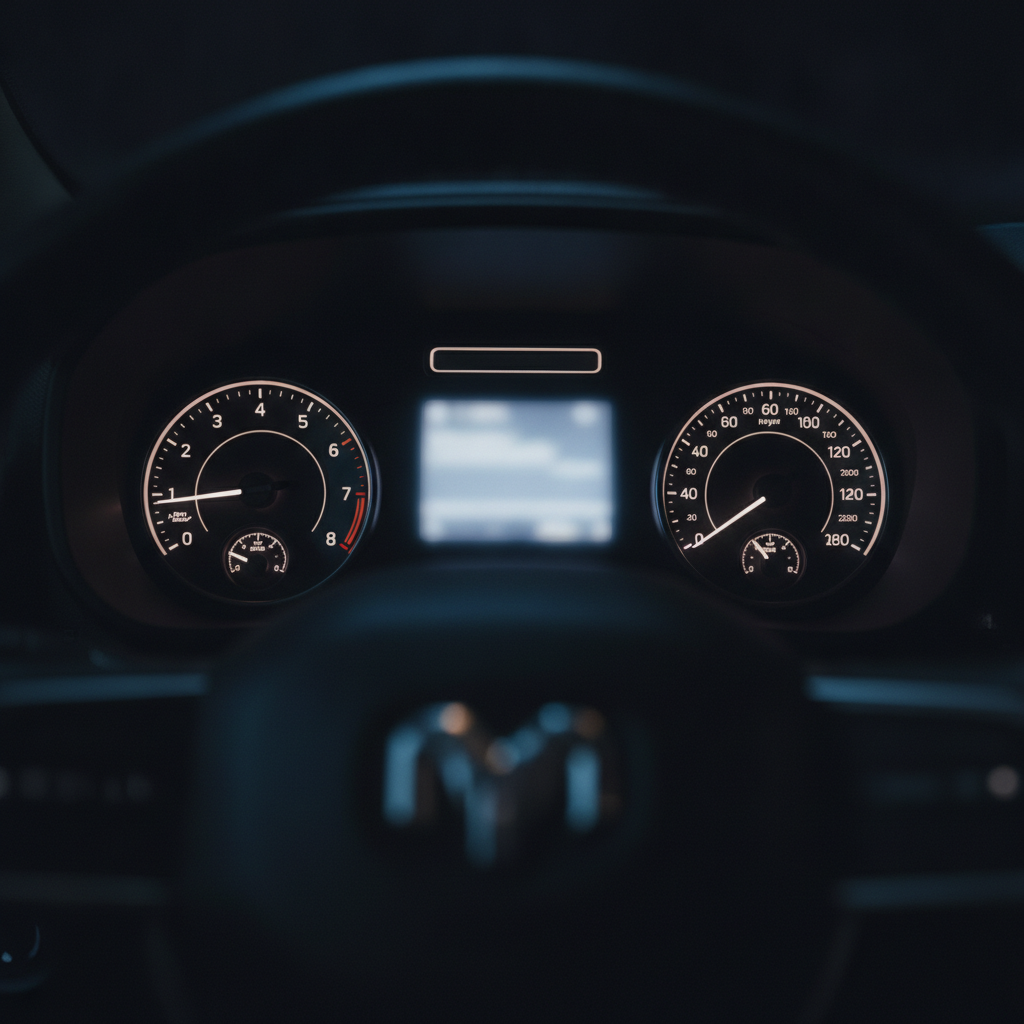
The message came up on the dash sometime last week and you have been driving around with it ever since, half wondering whether it means the oil is bad right now or whether it is just the truck being keen. Then somebody at work tells you there is a trick with the key and the gas pedal that makes it go away.
There is a reason we are going to answer the second half of that question differently than you expect. The light is more useful than most owners realise, and making it disappear is not the same as dealing with it. If your vehicle is due, book service and it gets handled properly, reset included. Here is what the system is actually doing and what the honest answer on resetting it is.
Key Takeaways
- It is not a kilometre countdown. Ram describes the Ram 1500 as having an automatic oil change indicator system that tells you when service is due, and says it varies based on driving habits such as frequent short trips or trailer towing.
- Mopar treats it as a maintenance reminder, not an emergency. When the light comes on, that is your reminder that it is time to come in for scheduled maintenance.
- A published ceiling sits over top of it. On a gas engine, Ram Canada states that under no circumstances should oil change intervals exceed 16,000 km or 12 months.
- Dust and off road use shorten it a long way. For dusty or off road driving, the guidance is not to exceed 6,500 km between oil changes on a gas engine.
- We are not going to print a button sequence, and that is deliberate. The procedure varies by model, model year and equipment, and the authority for your specific vehicle is its own owner's manual.
- Resetting without changing the oil breaks the only feedback you have. After that the system is reporting on a service that never happened, and so is every future reading it gives you.
What the System Is Actually Watching
Most people picture a mechanical counter that somebody set at the factory: drive this far, light comes on, reset, repeat. That is not what is happening, and the difference is the whole point.

Ram describes the Ram 1500 as equipped with an automatic oil change indicator system that will let you know when service is due, and states that this can vary based on your driving habits, such as frequent short trips or trailer towing. Read that as the technical statement it is. A fixed distance counter cannot vary with how you drive. It varies because the vehicle is watching how the engine is actually being used and drawing the remaining oil life down at a rate that matches.
So the message arriving is the vehicle telling you something specific about your last few months, not reading a number off a chart. Two identical trucks that left the same lot on the same day will ask for service at genuinely different odometer readings, and both of them will be right.
What brings it on sooner. Frequent short trips, where the engine never reaches and holds full operating temperature. Towing, which loads the engine and runs it hotter for sustained periods. Extended idling. Cold starts, which in this province means most of the winter. Dusty conditions, which out here means gravel.

What stretches it out. Long steady highway runs at temperature, with the engine doing the thing it is most efficient at and the oil spending its life hot enough to boil off the moisture that would otherwise sit in it.
That is why the truck that runs to Winnipeg and back twice a week can go further between changes than the one that does five minute trips across town all winter, even though the second truck shows a fraction of the kilometres. The system is measuring duty, and duty is not distance.
The Two Numbers That Sit Over Top of It
The indicator decides the interval within a range, but it does not get the final word, and the limits are published.
On a gas engine, Ram Canada states that under no circumstances should oil change intervals exceed 16,000 km or 12 months. That is a hard ceiling and the 12 months applies on its own, which matters for a low kilometre second vehicle or a truck that only comes out for hauling season. If the message has stayed away for fourteen months, the calendar has already made the call for you.
The second number is the one that reshapes the answer for a lot of vehicles around here. For dusty or off road driving, the guidance is not to exceed 6,500 km between oil changes on a gas engine. If a gravel road is part of your regular route, that is your number, and it is less than half the general ceiling. Fine dust that gets past filtration ends up circulating in the oil as an abrasive, and shortening the interval is how it leaves.
Diesel is its own conversation. Ram points diesel owners, and anyone driving under more strenuous conditions, at the owner's manual for exact requirements rather than publishing a single figure. We would rather look yours up than have you apply a gas engine number to a Cummins.
Why We Will Not Print the Reset Sequence

This is the part of the article you searched for, so here is the straight answer rather than a runaround.
The reset procedure is not one procedure. It differs across the Ram, Jeep, Dodge and Chrysler lineup, it differs by model year within a single model, and it differs by what your particular vehicle has in it, because a vehicle with a full touchscreen menu system does not reset the same way as one where everything happens through the cluster controls. The correct sequence for a Grand Cherokee three model years apart can be two different sequences.
That is exactly why publishing a generic set of steps is a bad idea. A blog post cannot know which vehicle is in front of you, and a sequence that is right for one truck and wrong for yours does not fail politely. At best nothing happens and you decide the system is broken. At worst you have been pressing through a menu you did not intend to be in.
The authority for your vehicle is its own owner's manual, which carries the procedure for your exact model year and equipment. Nobody at our counter will be annoyed if you call and ask us to look it up either. It takes a minute and we have the documentation for whatever you are driving.
The other honest answer is that on most vehicles you never need to do it yourself, because the reset is part of the oil change. Whoever changes the oil resets the message. If yours is still showing after a service, that is a five second fix and worth mentioning rather than living with.
The Habit Worth Breaking
There is a version of this that shows up on used vehicles and it is worth naming plainly.
Someone learns the reset sequence, the message becomes an annoyance rather than information, and it starts getting cleared whenever it appears. The oil gets changed sometimes. The message gets cleared every time. After a couple of years the two have nothing to do with each other.
What that costs you is not abstract. The system is the only running record the vehicle keeps of how it has been used and when it was last serviced, and clearing it without the service replaces real information with a number that means nothing. The next person to look at that vehicle, whether that is us, another shop, or a buyer, has no signal to read.
There is a warranty edge to it as well. Mopar's position is that owners must operate and maintain the vehicle as recommended in the owner's manual to maintain warranty coverage. Maintenance you actually did but cannot show is a weak position to be in, which is the practical argument for keeping invoices somewhere you can find them. A documented service history is also worth real money when the vehicle sells, which our post on Ram 1500 depreciation and resale gets into.
And to be clear about the reverse case, because it comes up: a message that will not clear after a genuine oil change is a different problem than a message you are tempted to clear without one. If a reset does not take, that is worth having looked at rather than repeated. Our post on Uconnect screen problems covers the display side of things, and if a warning light is behaving strangely more generally, our post on what the check engine light means is the place to start.
What to Do When the Message Comes On
It is a reminder, not an alarm, so there is no need to pull over. But it is not a suggestion either.
Book it in reasonably soon rather than when it becomes convenient. Mopar's framing is that the light is your reminder that it is time to come in for scheduled maintenance. It has already accounted for how you have been driving.
Check the date on your last oil change while you are at it. If it has been close to a year, the calendar limit applies regardless of what the message says.
Have the rest of the vehicle looked at during the same visit. The oil change is the appointment where the underside gets seen, and on prairie vehicles the underside is where the news usually is. Our service department guide covers what a proper visit includes, and the full Ram 1500 maintenance schedule covers what else comes due alongside it.
Do not clear it and carry on. That is the one move that costs you something later.
FAQs
How do I reset the oil change light on a Ram or Jeep?
The procedure depends on your specific vehicle, because it varies by model, by model year and by the equipment in the vehicle, particularly whether the reset runs through a touchscreen menu or the instrument cluster controls. The authority for your vehicle is its own owner's manual, which carries the correct sequence for your exact configuration. We are not going to publish a generic sequence, because one that is wrong for your vehicle does not fail politely. Call us and we will look up yours, or let the shop that changes your oil handle it, since the reset is normally part of the service.
Is the oil change indicator a kilometre countdown?
No. Ram describes it as an automatic oil change indicator system that lets you know when service is due, and states it can vary based on driving habits such as frequent short trips or trailer towing. It draws down based on how the engine is actually being used, which is why two identical vehicles ask for service at different odometer readings.
What makes the oil change light come on sooner?
Frequent short trips where the engine never fully warms up, towing, extended idling, repeated cold starts and dusty or off road driving all bring it on earlier. Ram specifically names short trips and trailer towing. Long highway runs at steady operating temperature stretch it out.
Can I keep driving after the message appears?
Yes, within reason. It is a maintenance reminder rather than a fault warning, and Mopar frames it as your reminder that it is time to come in for scheduled maintenance. It is not asking you to stop driving, it is asking you to book. The limit you should not push past on a gas engine is 16,000 km or 12 months, whichever comes first, and 6,500 km if you drive dusty or off road.
Is it bad to reset the indicator without changing the oil?
It is a habit worth breaking. The system is the vehicle's running record of how it has been used and when it was last serviced, and clearing it without the service replaces real information with a meaningless number, for you and for anyone who looks at the vehicle later. Mopar also states that owners must maintain the vehicle as recommended in the owner's manual to maintain warranty coverage, and keeping the reminder honest is part of that.
The message will not clear after my oil change. What now?
That is worth having looked at rather than repeating the attempt. It may simply be that the reset step was missed during the service, which is a quick fix, or it may be something in the vehicle's display side. Either way, bring it in or call and we will sort it out.
The Bottom Line
The oil change indicator is one of the few things on the dash that is genuinely working for you. It is watching how the vehicle is actually being driven, not counting to a number somebody picked in advance, and the message arriving is real information about your last few months of short trips, gravel, towing or highway.
The published limits still sit over top of it: 16,000 km or 12 months on a gas engine, and 6,500 km if you drive dusty or off road. The reset belongs with the oil change rather than instead of it, and the correct procedure for your vehicle lives in your vehicle's own manual rather than in a generic list of button presses.
If the message is on right now, book it in and we will change the oil, reset it properly and tell you what the underside looks like while it is up. If you would rather ask a question first, call our service centre or our parts department and we will look up whatever your vehicle needs. And if it turns out you are thinking about something newer instead, our new Ram 1500 inventory and new Jeep Grand Cherokee inventory are both online and current.
Tyler Dunn, Dunn Ram Trucks, Portage la Prairie