Somebody at work told you 5,000 kilometres. The guy at the counter years ago said 8,000. The truck itself has not said anything yet, and the little light on the dash has been quiet for a while now, which is either reassuring or slightly suspicious depending on your mood.
It is the most asked question in our shop and the one with the most bad answers floating around it, most of them inherited from vehicles built decades ago. The real answer is published by Ram, it has a hard ceiling, and out here there is a second number that matters more than most owners realise. If your truck is due, you can schedule service in a couple of minutes. Here is what the interval actually is and how to read your own truck against it.
Key Takeaways
- There is a published ceiling and it is not soft. Ram Canada states that oil change intervals should not exceed 16,000 km or 12 months, whichever comes first, on a gas engine. Mopar's own wording is blunter: under no circumstances.
- The 12 month half of that matters as much as the kilometres. A low mileage truck still needs its oil changed once a year. Time is a limit on its own, not a fallback.
- There is a much shorter number for how a lot of us actually drive. For dusty or off road driving, Ram Canada says do not exceed 6,500 km between oil changes on a gas engine. On a gravel road, that is the number that applies to you.
- The oil change indicator is not a kilometre countdown. Ram describes it as an automatic system that tells you when service is due and says it varies with driving habits such as frequent short trips or trailer towing.
- Short winter trips are hard on oil. A truck that never fully warms up is running under conditions the severe schedule exists for, which is most of December in a town this size.
- Diesel is a different conversation. Ram points diesel owners and anyone driving under more strenuous conditions at the owner's manual for exact requirements rather than a single published figure.
The Number Ram Actually Publishes
Let us start with the part that is not open to interpretation, because there is a lot of folklore in this topic and very little of it is sourced.

Ram Canada's maintenance guidance is that oil change intervals should not exceed 16,000 km or 12 months, whichever comes first. Mopar's service and maintenance page puts the same line more forcefully, stating that under no circumstances should oil change intervals exceed 16,000 km or 12 months on a gas engine.
Two things about that sentence deserve attention, because most people only hear half of it.
It is a ceiling, not a schedule. It is the maximum. It is not a recommendation to drive 16,000 km between changes, and Ram does not present it as one. It is the line past which you are outside the maintenance the vehicle is designed around, which also puts you outside what you agreed to when the warranty was written.

The 12 months applies even at low kilometres. This is the one that catches farm trucks, second vehicles and anything that only comes out for hauling season. Oil does not sit inert. It collects moisture from condensation, it collects combustion byproducts, and the additive package that does most of the protective work depletes over time whether the truck is moving or not. A truck that ran 4,000 km last year still needs its oil changed. Whichever comes first means exactly what it says.
The Number That Actually Applies Out Here

Here is the figure almost nobody quotes, and it is the one that changes the answer for a lot of trucks in this part of Manitoba.
For dusty or off road driving, Ram Canada's guidance is not to exceed 6,500 km between oil changes on a gas engine. That is less than half the general ceiling, and it is not a suggestion buried in fine print, it is stated plainly alongside the main figure.
Now think about how your truck actually lives. If your daily route includes a gravel road, if you turn down an approach to a yard, if you run section roads in August behind combines, or if the truck sits in a yard while the wind moves topsoil across it, you are the dusty driving case. Not occasionally. That is your normal.
Fine dust is the reason the number drops that far. Airborne grit that gets past filtration ends up suspended in the oil, and once it is there it is an abrasive circulating through every bearing surface in the engine. Oil is very good at holding contaminants in suspension, which is exactly its job, and the flip side of that job is that the contaminated oil has to leave. Shorter interval, cleaner engine.
The same logic explains why the air filter is part of this conversation rather than a separate one. Our post on the Ram 1500 air filter change interval covers that side, and on a gravel truck the two get looked at together every time.
What the Oil Change Indicator Is Really Measuring
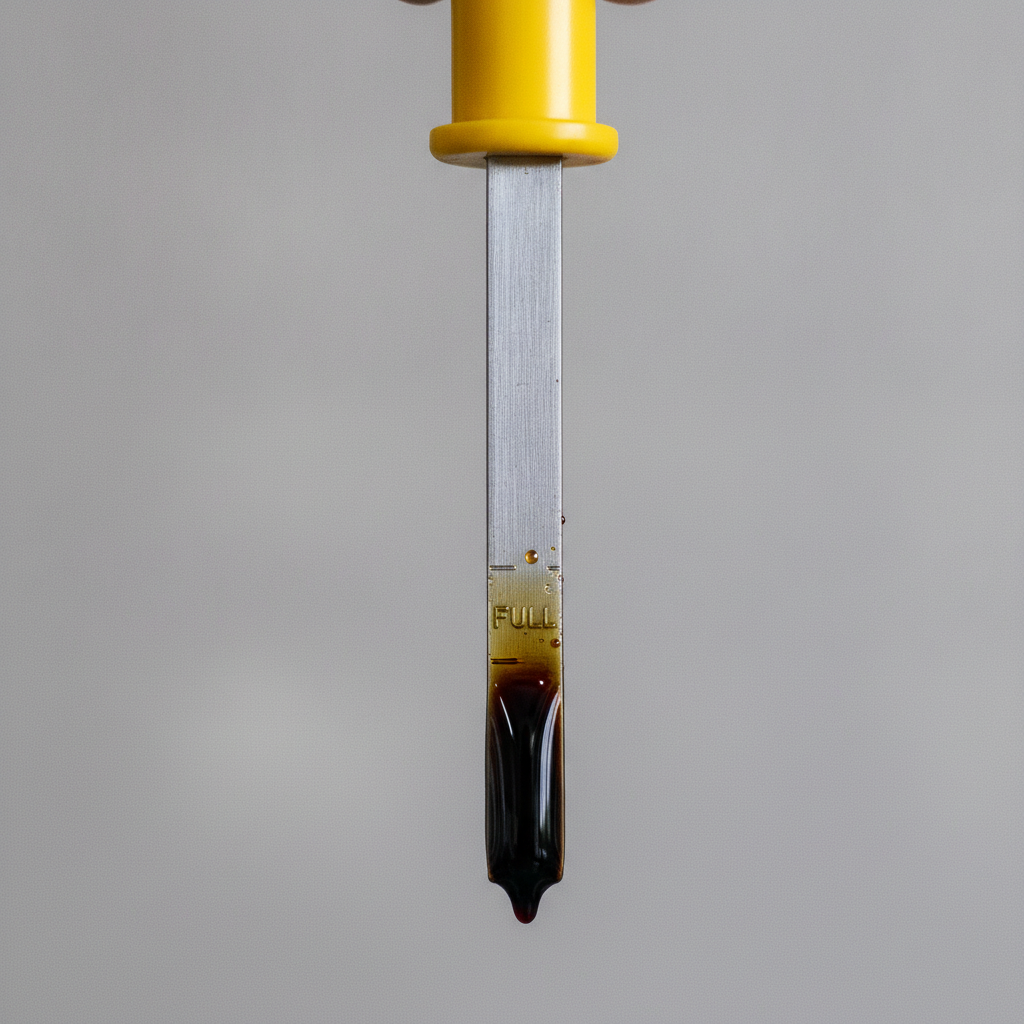
Plenty of owners assume the indicator is a distance counter that somebody set at the factory. It is not, and understanding the difference makes it a genuinely useful tool instead of a nag light.
Ram describes the Ram 1500 as equipped with an automatic oil change indicator system that lets you know when service is due, and states that this can vary based on your driving habits, such as frequent short trips or trailer towing. That last clause is the important one. If it were a fixed odometer countdown, driving habits could not vary it. It varies because the system is watching how the engine is actually being used and drawing down accordingly.
What follows from that is worth knowing:
Hard use brings it up sooner, and that is correct. A summer of pulling a stock trailer or a winter of five minute trips will bring the message on earlier than a summer of highway kilometres. The truck is not being fussy. It is reporting a real difference.
A quiet indicator is not permission to ignore the calendar. The published ceiling of 16,000 km or 12 months still applies over top of whatever the system says. If the light has stayed dark for fourteen months, the calendar has already made the decision.
It reports on oil condition, not on the rest of the truck. The oil change is the visit where tires, brakes, fluids and the underside get looked at, and on prairie trucks the underside is where the news usually is. Our service department guide covers what a proper visit includes.
Reset discipline matters too, and it is simple. The message is reset as part of the oil change, by whoever did the oil change. Clearing it without changing the oil breaks the only feedback the system gives you, and the next person to look at that truck has no idea when it was last serviced.
Why a Manitoba Winter Shortens the Interval
Ram names frequent short trips as one of the things that varies the interval, and in this province that description covers most of the winter for most people.
The mechanism is not complicated. An engine that reaches full operating temperature and stays there burns off the moisture and unburned fuel that inevitably work their way into the oil. An engine that gets started at minus 30, driven ten minutes across town and shut off never gets there. Do that twice a day for four months and you have a crankcase that has been collecting what it should have been evaporating.
That is the real reason the severe service schedule exists, and it is why a truck that only does short town trips can be harder on oil than one that runs highway to Winnipeg every day, despite the second truck putting on four times the kilometres. Distance is not the same as duty.
The practical version for a Manitoba owner is straightforward. If your winter is mostly short trips, treat your interval as the shorter one rather than the ceiling. If you plug in and let the truck actually warm up, you are helping more than you think, and our block heater guide covers why. And if your truck does both, gravel in summer and short trips in winter, then the honest read is that the shorter number is simply your number year round.
So What Should You Actually Do
The short version, without hedging.
Highway driving, paved roads, full warm ups, no towing: follow the oil change indicator, and never let it go past 16,000 km or 12 months regardless of what the indicator says.
Gravel roads, dusty conditions or off road use: do not exceed 6,500 km, per Ram Canada's own guidance for dusty and off road driving.
Mostly short winter trips, or regular towing: treat yourself as severe service. The indicator will tend to agree with you if you let it do its job.
Low kilometre truck: once a year, no matter what the odometer says.
Diesel: ask us or read your manual rather than applying a gas engine number. Ram directs diesel owners and anyone driving under more strenuous conditions to the owner's manual for exact requirements, and we would rather look yours up than guess at it.
What you use is a separate question from how often, and we deliberately keep them separate. Our post on synthetic versus conventional oil in a Ram 1500 covers the oil choice, and the full Ram 1500 maintenance schedule covers everything else that comes due alongside it. If you want the local logistics rather than the theory, our oil change page for Portage la Prairie has it.
FAQs
How often should I change the oil in my Ram 1500?
Ram Canada states that oil change intervals should not exceed 16,000 km or 12 months, whichever comes first, on a gas engine. That is the maximum rather than the target. Your truck's oil change indicator system determines the actual interval based on how it is being driven, and Ram notes this varies with driving habits such as frequent short trips or trailer towing. If you drive dusty or off road, a much shorter figure applies.
What is the oil change interval if I drive gravel roads?
Ram Canada's guidance for dusty or off road driving is not to exceed 6,500 km between oil changes on a gas engine. If a gravel road is part of your regular route, that is your interval rather than the 16,000 km ceiling. Airborne dust that gets past filtration ends up circulating in the oil as an abrasive, and the shorter interval is how you get it out.
Do I still need an oil change if I barely drive the truck?
Yes. The published limit is 16,000 km or 12 months, whichever comes first, so the 12 months applies on its own. Oil picks up moisture from condensation and its additive package depletes with time regardless of distance driven. A truck that only comes out for hauling season still needs its oil changed annually.
Is the oil change light a kilometre countdown?
No. Ram describes it as an automatic oil change indicator system that lets you know when service is due, and states that it varies based on driving habits such as frequent short trips or trailer towing. A fixed odometer counter could not vary that way. It responds to how the engine is actually being used, which is why a hard summer brings the message on sooner than an easy one.
Does towing change my oil change interval?
It does, and the system accounts for it. Ram specifically names trailer towing as one of the driving habits that varies the interval, so a truck that tows regularly will call for service sooner than the same truck running empty. Treat a towing season as severe service and let the indicator do its work rather than counting kilometres.
What oil does a Ram 1500 take?
That depends on the engine, and it is worth getting right. Ram Canada lists Mopar SAE 0W-20 full synthetic for the 3.0L Hurricane standard output, the 3.6L Pentastar V6 with eTorque and the 5.7L HEMI V8 with eTorque, and Mopar API Certified SAE 0W-40 full synthetic for the 3.0L Hurricane high output. Confirm against your own owner's manual or ask our parts department, because the grade is engine specific rather than model specific.
Does going past the interval affect my warranty?
Maintaining the vehicle as recommended in the owner's manual is part of the deal, and Mopar states plainly that owners must operate and maintain the vehicle as recommended to maintain warranty coverage. Keep your invoices. A documented service history is the thing that answers the question if it is ever asked, and it is worth real money at resale as well.
The Bottom Line
The honest interval for a Ram 1500 is not one number, it is a ceiling and a condition. The ceiling is 16,000 km or 12 months on a gas engine, whichever comes first, and Ram treats that as absolute. The condition is how your truck actually lives, and if that involves gravel or dust, Ram's own guidance drops you to 6,500 km. Let the oil change indicator make the call in between, and let the calendar make it on a truck that does not move much.
Out here, most trucks are closer to the short number than the long one, and there is nothing pessimistic about saying so. It is just what gravel and minus 30 do. When yours comes due, book it in and we will tell you what we find underneath while it is on the hoist. If you are shopping instead of servicing, our new Ram 1500 inventory and used inventory are both online and current.
Tyler Dunn, Dunn Ram Trucks, Portage la Prairie