Most people find out about their brake lines on the worst possible day. The truck is sold, the buyer is standing there with a bank draft, and the inspection station calls to say it will not pass. Or worse, the pedal goes soft on a gravel approach and there is no warning at all, because a steel line does not creak or squeal on its way out. It rusts quietly for eight winters and then lets go in one afternoon. If your truck is heading for a sale or a safety this year, the smart move is to get underneath it early rather than late, and you can book an inspection with our service department while there is still time to do something about it.
This is the version we would give you across the counter in Portage la Prairie, and it is one of the genuinely local pieces of vehicle ownership out here. Manitoba salts and brines its highways, our trucks work on gravel that holds moisture against everything underneath, and the lines that carry brake fluid and fuel run the whole length of the frame through all of it. Here is what the inspection standard actually says, where the lines go first, and why the cheap patch you were offered is not a repair.
Key Takeaways
- The standard is not about how rusty a line looks. It is about whether it leaks and how it was repaired. Manitoba's inspection handbook rejects a brake line for any leak at all, including seepage too small to form a drop.
- A welded, soldered or compression fitting repair on a brake line is an explicit reject. So is non approved tubing. That is the rule that makes a spliced patch section fail, no matter how neat it looks.
- Fuel lines have their own standard. A gasoline system is a hazardous condition for any leak at all, at any point. A diesel system fails on a leak that forms drops.
- Where they go first is predictable. Under the clips, over the rear axle, along the frame rail and anywhere brine gets trapped and stays wet.
- The best time to check is now, not in November. Line work on a dry truck in August is a normal job. Line work on a frozen truck in a hurry is a different conversation.
What Manitoba's Inspection Standard Actually Says
Manitoba's rules live in the Vehicle Inspection Handbook for Manitoba, which is a schedule to the province's Vehicle Equipment, Safety and Inspection Regulation. It is a plain document with a column headed "reject if," and that column is where an inspector lives. Two of its sections matter here.

Section 3.2 covers brake lines, hoses and the master cylinder. For lines and fittings, the handbook lists a reject for a level 1, level 2 or level 3 leak of brake fluid, and for a line that is cracked, insecure, loose, twisted, welded, soldered, chafing, restricted, contacting any moving part, or using non approved tubing, fittings or compression fittings.
Those leak levels are defined in the handbook itself, and the definitions are worth knowing because they are stricter than most owners expect. A level 1 leak is seepage that is not even great enough to form drops. A level 2 leak forms drops but they do not fall during the inspection. A level 3 leak forms drops that fall. On the brake system, all three fail. On top of that, a hose or line that swells under pressure, or a level 2 or 3 brake fluid leak anywhere in the system, is listed as a hazardous condition.
Read that once more, because it is the whole point. There is no percentage of surface rust you are allowed. A line can look terrible and pass if it is sound, secure and dry, and a line can look tidy and fail because it is weeping where you cannot see.

Section 1.3.1 covers the fuel system. A gasoline system with a level 1, level 2 or level 3 leak of gasoline at any point is a hazardous condition, so gasoline gets no seepage allowance whatsoever. A diesel system fails on a level 2 or level 3 leak. Fuel lines themselves are a reject if they are cracked, inferior, insecure, rubbing, cut, or worn to the cord layer, and either a brake line or a fuel line is a reject if it sits within 25 mm of the exhaust system without a heat shield protecting it.
That last one catches trucks that have had exhaust work done at some point in their life. It is not a corrosion issue at all, and it fails just the same.
Why Manitoba Kills Lines Faster
Salt is the headline, but it is the way we use it that does the damage.
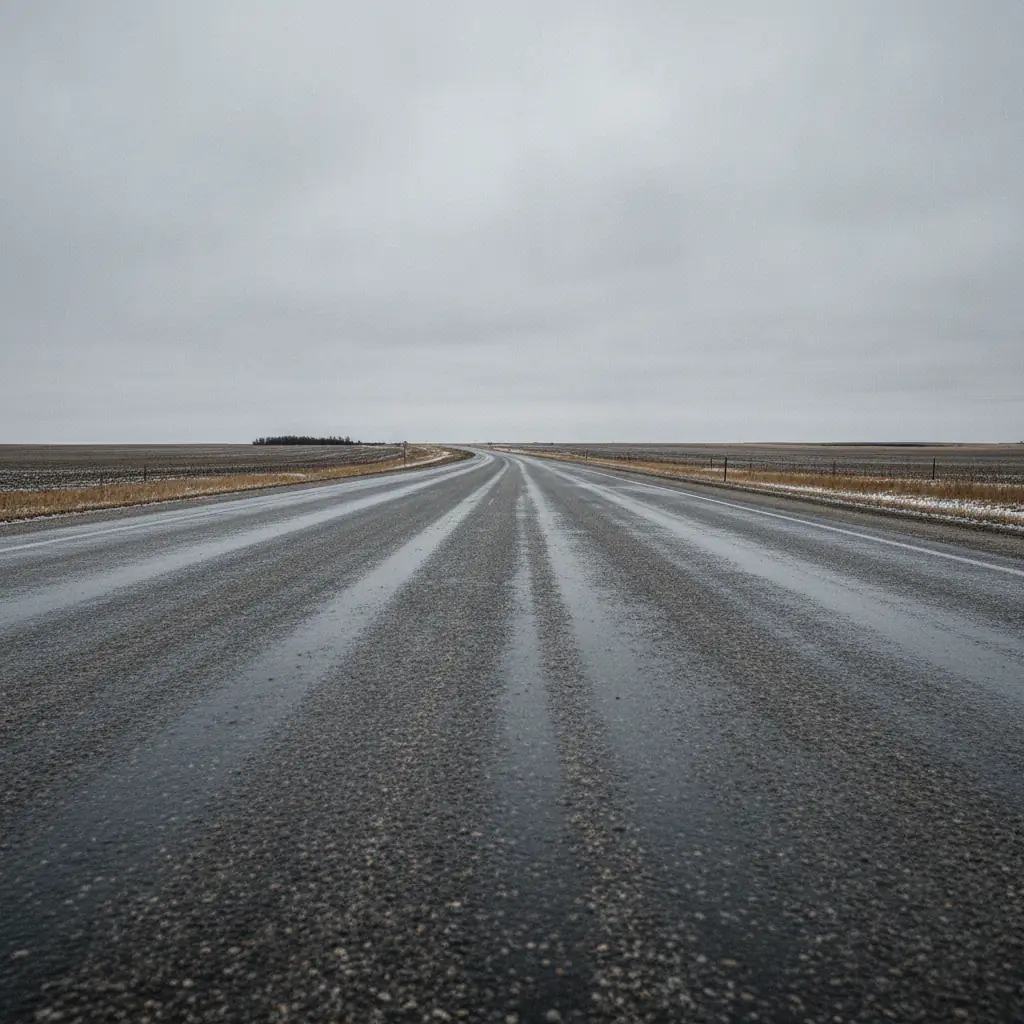
Straight rock salt at deep cold does not do much, so highway maintenance moves to liquid brine and treated salt that stay active at lower temperatures. That is genuinely good for traction. It is brutal on steel, because a brine is engineered to stay wet and to creep into places dry salt never reaches. It gets behind clips, into seams, up under coatings, and it does not simply blow off on the next dry day.
Then add what our trucks actually do. A truck that spends its winter on Highway 1 and its summer on grid roads collects a layer of fine gravel dust that holds moisture against the underside like a poultice. Park it in a heated shop overnight and you get a wet, warm, salted surface for hours, which is a far better corrosion environment than a cold truck sitting outside. That is the honest reason a farm truck in a heated quonset sometimes rots faster underneath than the one that sleeps in the yard.
Where they go first, in the order we see them:
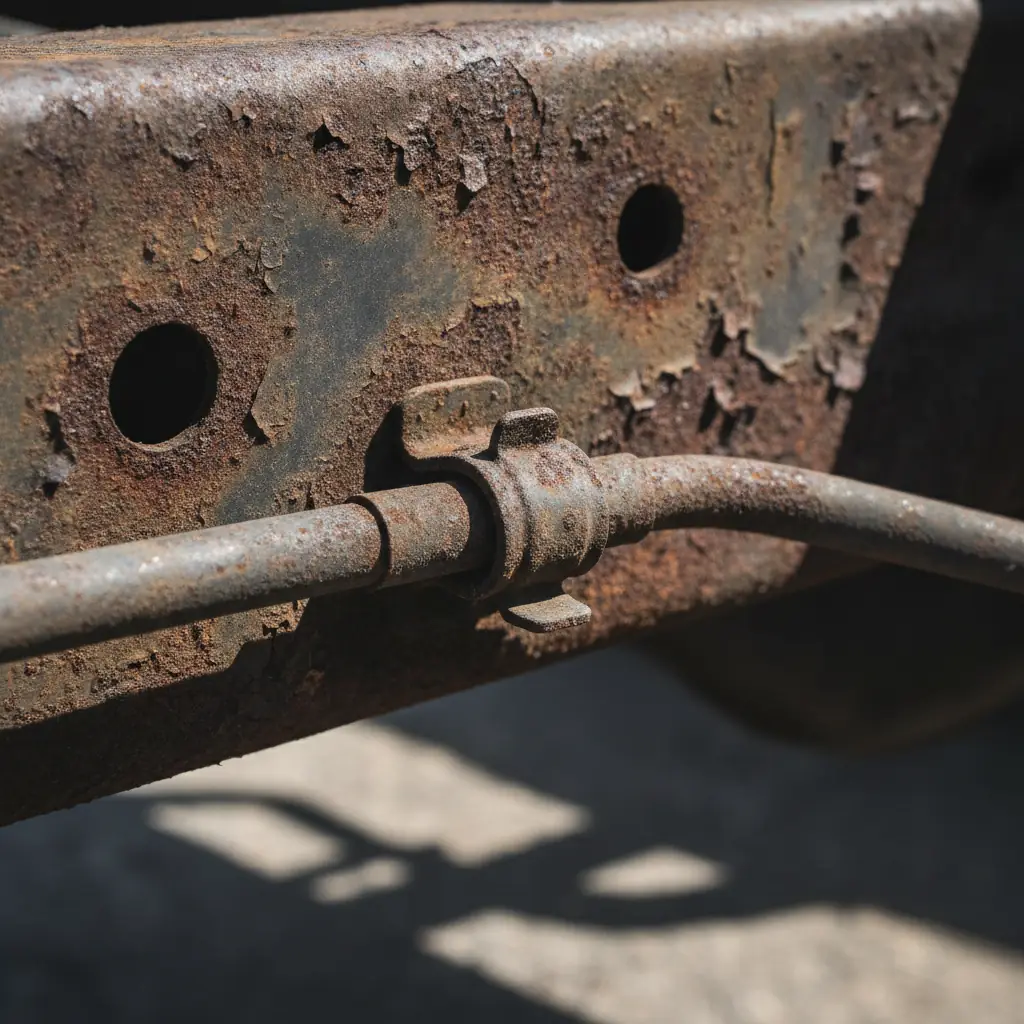
Under the clips and along the frame rail. Anywhere the line is held against the frame there is a crevice, and a crevice holds brine. The line looks fine either side of the clip and is gone underneath it.
Over the rear axle. The lines arc up over the axle in the direct firing line of everything the rear tires throw. It is the single most common failure zone we see on prairie trucks.
At the flexible hose junctions and near the master cylinder. Fittings collect and hold moisture, and dissimilar metals in contact accelerate the process.
Anywhere a previous repair sits. A section that was cut and joined once is a section with two more fittings in it, and fittings are where the trouble starts.
Rust is not only a line problem, either. The same handbook rejects a suspension tower that is cracked, rust perforated or corroded, and it requires that a repair there be welded using an OEM approved method. Corrosion is a structural item in Manitoba, not a cosmetic one, and if you are thinking about the whole picture our guide to getting a truck ready for a Manitoba winter covers the habits that slow all of this down.
Why a Patch Section Is Not a Repair
This is where the money and the argument usually happen, and the standard is unusually clear about it.
Somebody will offer to cut out the rotten stretch and join in a new piece with a compression fitting. It is fast, it is cheap, and it holds pressure on the bench. It is also an explicit reject item in Manitoba: the handbook names welded, soldered, and non approved tubing, fittings or compression fittings in the same breath as a cracked or leaking line. An inspector who finds one is not exercising judgement. They are reading the list.
There is engineering behind the rule, not just paperwork. A brake system runs very high pressure in short, violent spikes, and it does it on a truck that is flexing, vibrating and freezing. A proper brake line joint is a formed flare where the tubing itself is shaped to seal metal against metal, made in approved tubing to the right specification. A compression fitting relies on a ferrule squeezing the outside of the tube, and it is a plumbing solution living in a place that was never plumbing.
The other half of the honesty here is that a patch fixes the section that already failed and leaves the rest of a line that lived the same eight winters. If one length of a run has rotted through, the neighbouring lengths are the same age, the same steel, and were parked in the same yard. That is why a proper job on a truck this far along is usually replacing full runs rather than chasing spots, and it is why the estimate can surprise people. Our parts department can tell you what is available for your specific VIN, and we will not quote you a number on a truck we have not had underneath, because on line work the amount of surprise is real.
What This Means If You Are Buying or Selling
Corroded lines are one of the most common ways a private sale falls apart out here, so it is worth planning for.
If you are selling, get underneath the truck before you list it, not after somebody has committed. Manitoba requires a Certificate of Inspection in a number of situations including registering a vehicle you have bought or brought in from out of province, and our post on the Manitoba Certificate of Inspection walks through when one is required. Finding a line problem in August gives you options. Finding it with a buyer in your driveway gives you one, and it is not a good one. If the number turns out to be more than the truck is worth to you, take a look at what our instant cash offer on your trade says before you spend it.
If you are buying, especially a truck from a salted province, ask for the inspection and then look at the lines yourself anyway. A truck that looks clean from ten feet can be genuinely rotten underneath, and the price you negotiated does not include it. This is a large part of why we go over the underside on every unit before it goes on our used inventory, and it is worth reading our honest take on what mileage actually means on a used truck, because a low kilometre truck that spent every winter on brine is not the bargain the odometer suggests.
FAQs
How much rust on a brake line is too much in Manitoba?
The standard is not written as a percentage. Manitoba's inspection handbook rejects a brake line for any leak of brake fluid, including seepage too small to form a drop, and for a line that is cracked, insecure, loose, twisted, welded, soldered, chafing or using non approved tubing, fittings or compression fittings. Surface rust on a sound, dry, secure line is not automatically a fail. Rust that has compromised the line is.
Can I just replace the rusted section of brake line?
Not with a compression fitting, and not by welding or soldering it. Manitoba lists all of those as reject items on brake lines and fittings. A repair has to use approved tubing and proper formed connections, and on a truck where one run has rotted through, replacing complete runs is usually the sounder call anyway because the neighbouring sections are the same age.
Do rusted fuel lines fail a Manitoba safety too?
Yes. A gasoline fuel system is a hazardous condition for a leak at any point, at any of the three leak levels, so there is no seepage allowance at all. A diesel system fails on a leak that forms drops. Fuel lines are also a reject if they are cracked, insecure, rubbing, cut or worn to the cord layer.
Why do brake lines rust so badly here compared to other places?
Liquid brine and treated salt work at colder temperatures than plain rock salt, which is why Manitoba uses them, and they stay wet and creep into crevices rather than blowing off. Add gravel dust holding moisture against the underside and heated storage keeping that mixture warm and damp overnight, and you have close to ideal conditions for corrosion.
Is it safe to drive a truck with rusted brake lines?
If a line is only surface rusted and genuinely sound, it is not an emergency. If you have any brake fluid loss, a soft or sinking pedal, or a brake warning light, stop driving it and have it towed. A steel line does not give you audible warning the way pads do. It holds until it does not.
The Bottom Line
Rusted lines are the most Manitoba failure there is. We salt hard because we have to, our trucks work on gravel and sit in heated shops, and the parts that carry brake fluid and fuel run the full length of the frame through every bit of it. The standard the province applies is stricter than most owners assume, and it explicitly closes the door on the cheap patch.
The move is the same whether you are keeping the truck or selling it. Get it on a hoist while the weather is good and you have choices. Book it in with us and our service centre will tell you what is actually there, what will pass, and what will not, before somebody else's inspection makes the decision for you.
Tyler Dunn, Dunn Ram Trucks, Portage la Prairie