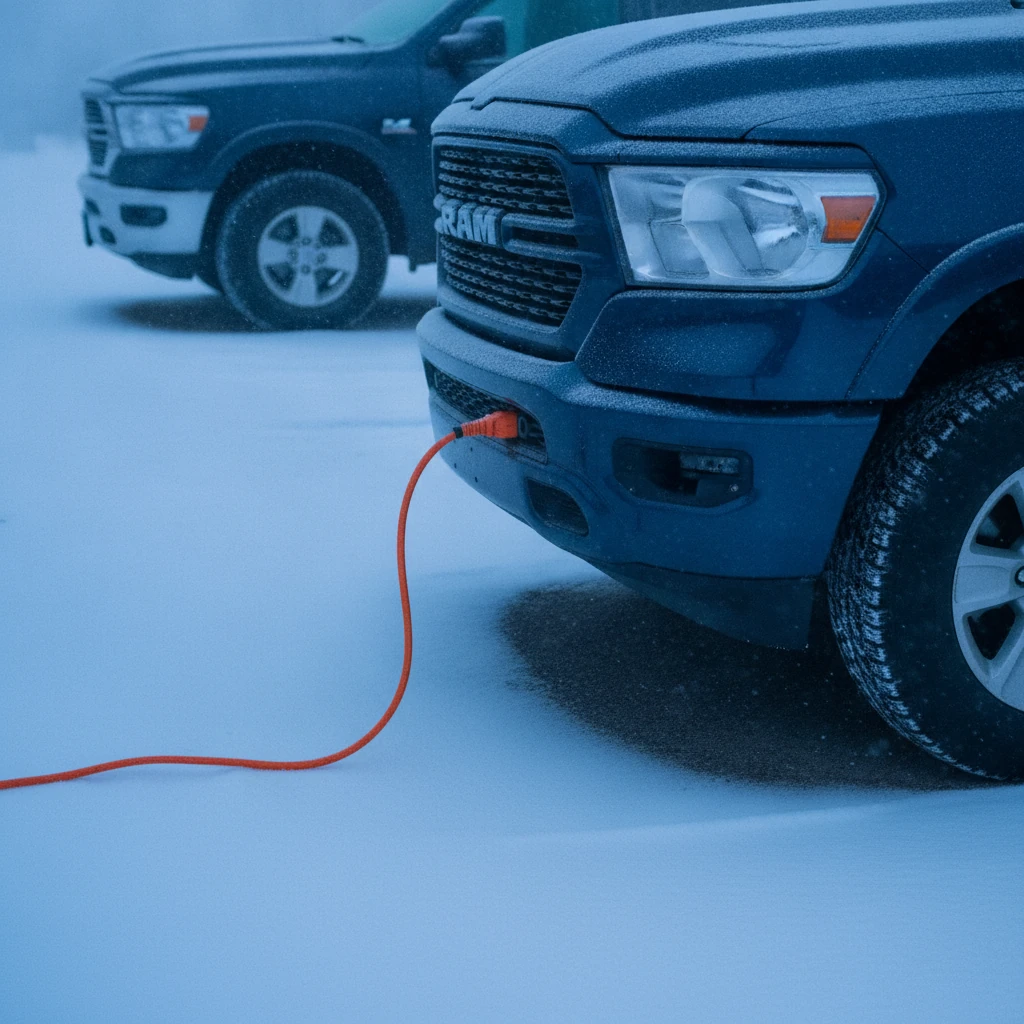
The first genuinely cold morning always catches somebody. It is usually somewhere around the middle of November, it is minus 26 with a wind, and half the trucks in the lot at work turned over slowly or not at all. The people whose trucks started are not lucky. They did about an hour of work back in October. If you want the short version of that hour, book a service appointment and we will do most of this list for you in one visit. If you would rather do it yourself, here is exactly what to do and the order to do it in.
This is written for a Manitoba winter specifically, not a generic Canadian one. We regularly sit below minus 30 out here on the open prairie, which is past the point where a lot of general advice stops being useful.
Key Takeaways
- The battery is the single highest value check. Cold cranking amps are rated at minus 18 by definition, and that is a mild day here. A battery that seems fine in October is the most common thing that fails in January.
- Plug in, but do not leave it plugged in all night. Manitoba Hydro's guidance, as reported by CBC, is that a vehicle does not need to be plugged in for more than four hours. A cheap timer does the job and stops you heating the block from midnight for nothing.
- Winter tires go on by temperature, not by snowfall. Transport Canada notes that below 7 degrees, all season and summer tires begin to lose elasticity and traction, while winter tires keep theirs at much lower temperatures. Install a full set of four.
- Fluids are the quiet failure. Washer fluid rated for a mild winter turns to slush on Highway 1 in January, and a diesel running summer blend fuel will gel.
- Diesel owners have three extra jobs: winter blend fuel, a fall fuel filter change, and understanding that the DEF in the tank freezes around minus 11 and the truck is built to thaw it.
- The kit in the back is not optional out here. The Manitoba Driver's Handbook publishes a specific list, and the distances between towns on our highways are the reason it exists.
Start With the Battery, Because It Is What Actually Strands You
If you only do one thing off this list, do this one.

The industry rating on your battery, cold cranking amps, is defined at minus 18 degrees: the current a new, fully charged battery can deliver for 30 seconds while holding at least 7.2 volts. Read that again. The reference temperature for the rating is a temperature we treat as a mild winter day. Everything below that is outside the number on the label.
Two things happen at once when it gets cold. The chemistry inside the battery slows down, so it delivers less current. At the same time the oil in your engine thickens, so the starter needs more current to turn it over. Demand goes up exactly as supply goes down, which is why a battery that has been quietly declining all year picks the coldest morning of the winter to quit.
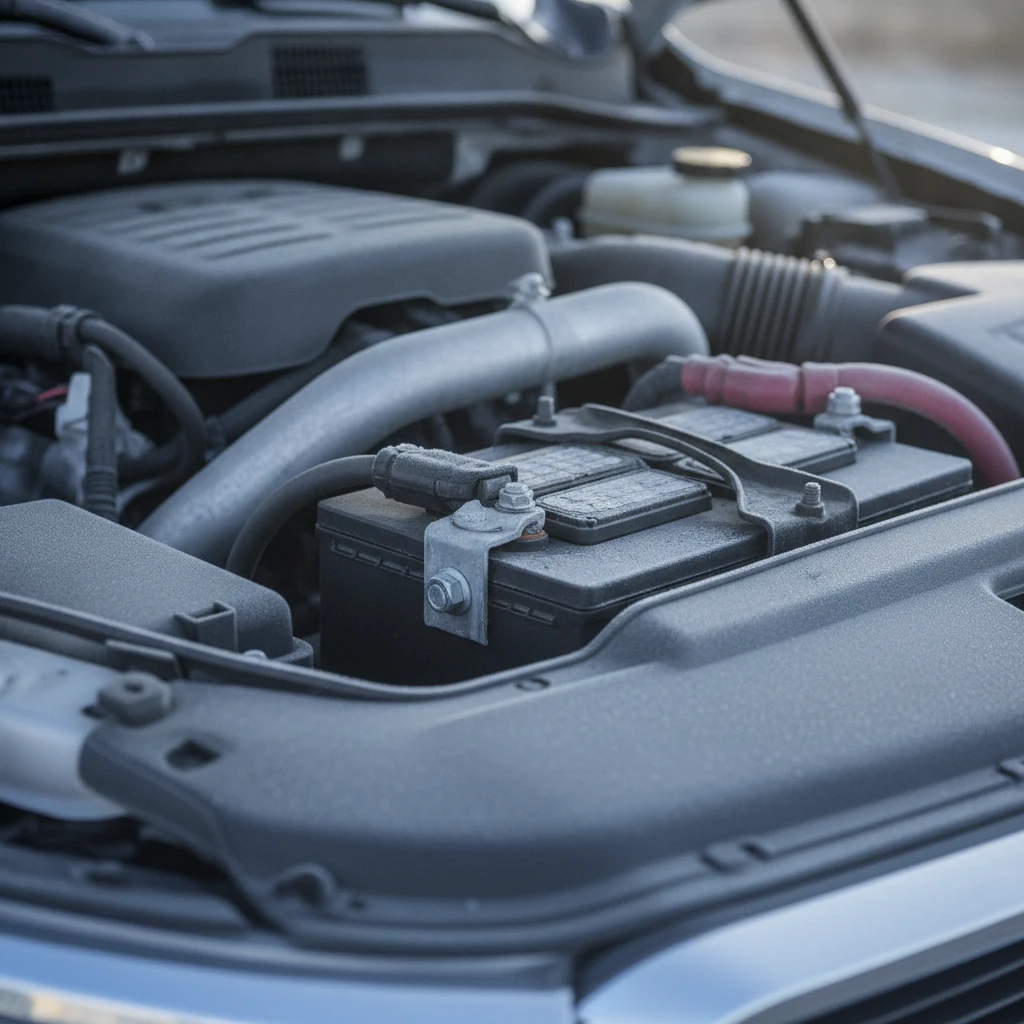
The fix is a load test, not a look. A visual inspection tells you nothing about a battery's remaining capacity. Any shop can put a tester on it in a couple of minutes and tell you whether it will make it through another winter. While it is out, clean the terminals, because corrosion adds resistance right where you can least afford it, and make sure the hold down is tight, since a battery that vibrates loose all summer on gravel does not last.

Most batteries in this climate give you three to five years. If yours is past four and you have not had it tested, that is the test to book. Our guide to Ram 1500 battery size covers what goes back in when the answer is a replacement.
The Block Heater, Used Properly
Almost every truck sold new in this province has a block heater. A surprising number of people either never use theirs or use it wrong.
What it does is warm the coolant, and through it the engine block and the oil, so that on start up the oil actually flows and the starter is not fighting cold molasses. That reduces the wear that happens in the first thirty seconds after a cold start, which is where most engine wear happens over a truck's life, and it means the cabin warms up faster too.
The part people get wrong is duration. Manitoba Hydro's guidance, as reported by CBC, is that a vehicle does not need to be plugged in for more than four hours. Most of the heating happens early. Leaving it plugged in from ten at night until seven in the morning gets you very little extra warmth and a noticeably larger bill across a Manitoba winter. A timer from any hardware store solves this for about twenty dollars: set it to come on a few hours before you leave and forget about it.
Two practical notes. Check the cord itself in the fall, because they get chewed by rodents, run over, and yanked out by people who drove away still plugged in, and a damaged cord is a real hazard. And if your truck does not have a block heater, or the element has failed, that is a job worth doing before the cold, not during it. Our parts department can sort out the right element and cord for your truck.
Tires: Go by the Thermometer
The single most repeated mistake in this province is waiting for snow.
Transport Canada is clear on the mechanism. Below 7 degrees, all season and summer tires begin to lose elasticity, which costs you traction, while winter tires keep their elasticity and grip at much lower temperatures. That means the day the tires stop working properly is a day that often has no snow on the ground at all, and it usually arrives in October.
Transport Canada also recommends installing winter tires in sets of four, so the vehicle stays stable and predictable, and looking for the peaked mountain with snowflake symbol when you shop. Two winter tires on the drive axle and two all seasons on the other end gives you a truck that grips at one end and lets go at the other, which is worse than a matched set of anything.
While you are at it, check your pressures once it turns cold and keep checking them, because air contracts and a tire that was correct in September will be low in November. If the set going on looks marginal, our post on when to replace truck tires walks through how to make that call properly.
Worth knowing: Manitoba Public Insurance runs a Winter Tire Program that lends eligible customers up to $2,000 per vehicle at prime plus 2 percent over one to four years, and it covers rims, mounting, balancing and alignment as well as the tires. Confirm the current terms with MPI, since the rate moves with the Bank of Canada.
Fluids: The Quiet Ones
Nothing about fluids feels urgent in October, which is exactly why they get skipped.
Washer fluid is the one you will notice first. Summer fluid or a mild winter blend freezes in the lines and the reservoir, and it happens on the day you need it, following a truck through slush on Highway 1 with a salt film on the glass and no way to clear it. Buy fluid rated well below the coldest night you expect, drain out what is in there if it is summer stuff, and carry a spare jug. Our post on defrosting your windshield covers the rest of the visibility problem.
Coolant is about protection level, not colour. The mix in your truck has a freeze point, and if someone has topped it up with water over the summer that freeze point has moved. It takes a minute to test and it protects the most expensive part of the truck. See our guide to coolant service on a Ram or Jeep for what a proper service involves.
Oil viscosity matters more here than in most places. Cold oil is thick oil, and thick oil is what your starter is fighting at minus 30. Run the winter grade your owner's manual specifies, and if you are between changes in the fall, get it done before the cold rather than after.
Door locks and seals. A shot of lock lubricant in the fall and a wipe of silicone or rubber conditioner on the door seals saves you a frozen door in January, which is a genuinely miserable way to start a day. We wrote a whole post on frozen car door locks in Manitoba because it comes up that often.
If You Run a Diesel, Three More Jobs
A Cummins is superb out here, but a diesel has cold weather homework a gas truck does not.
Fuel. Diesel contains paraffin wax that stays dissolved when it is warm and separates when it gets cold, which is what people mean by gelling. Fuel sold in Manitoba switches to a winter blend as the season turns, but a tank filled in September and left sitting is a summer blend tank. Run the tank down and refill with local winter fuel before the first hard cold, and talk to us about the conditioner appropriate for your engine rather than pouring in whatever is on the shelf.
Fuel filters. Change them in the fall, before the cold, not in a parking lot in January. A partly loaded filter is the first place wax collects, and a filter change is a cheap, scheduled job that turns into an expensive, unscheduled one if you wait.
DEF. Diesel exhaust fluid is roughly a third urea and two thirds water, and it freezes at about minus 11. That is normal and expected. Trucks with modern emissions systems have heaters in the DEF tank and lines and are designed to thaw it, and freezing does not harm the fluid or the truck. What does harm it is adding anything to it to stop it freezing, so do not. Our post on DEF on a Ram Cummins goes through the whole system.
What Lives in the Back All Winter
This is the part that stops being theoretical the first time you are in a ditch on a highway with no cell service and the temperature dropping.
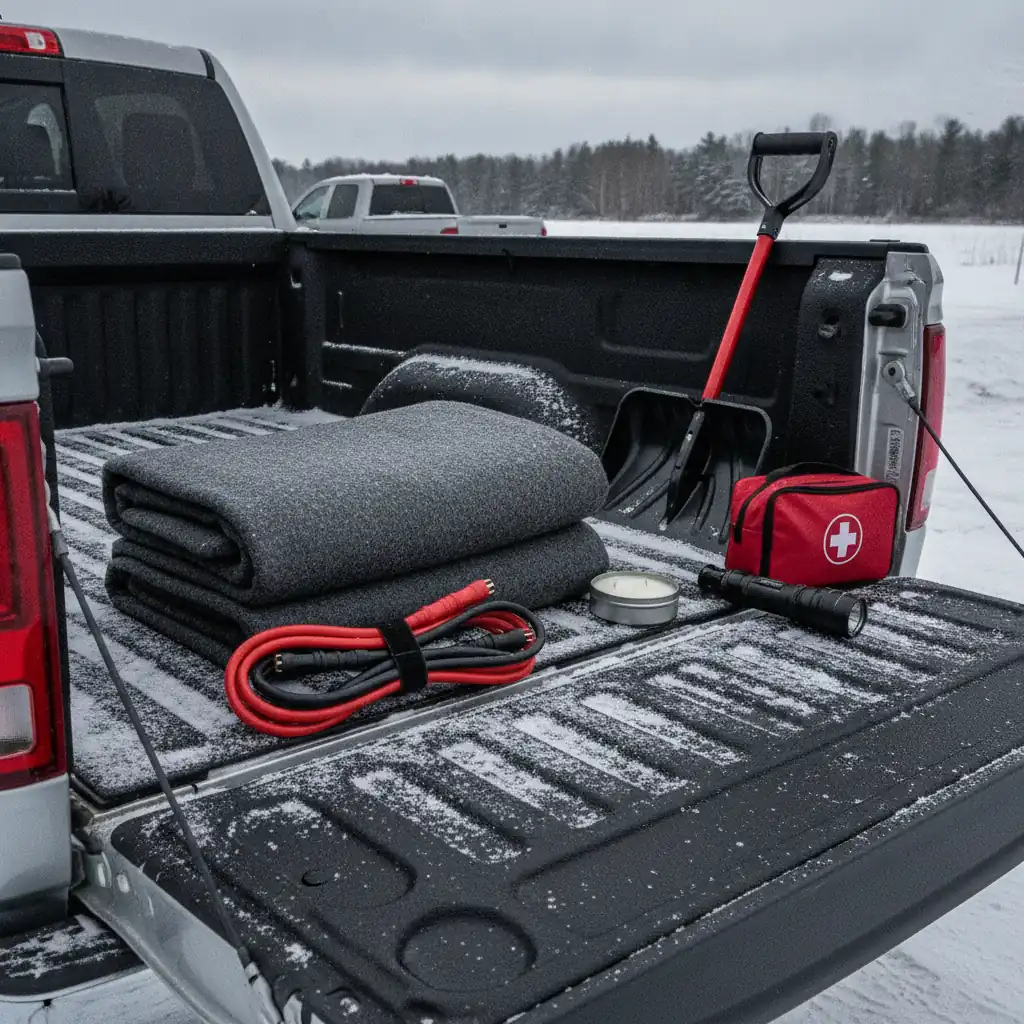
The Manitoba Driver's Handbook publishes its recommendation in three layers, and it is worth following as written. The base kit is a shovel, a tow rope or chain, booster cables, a flashlight, a first aid kit, a basic tool kit, flares and a fire extinguisher. The winter additions are a hatchet, chains or metal mats, a windshield scraper, a snow brush, gas line antifreeze, plus winter clothing, winter boots, a hat, mitts and blankets. The full winter survival kit adds waterproof matches, a compact stove with fuel, candles, a sheet of plastic or canvas, light rope, a blaze orange flag, a carbon dioxide indicator, aluminum foil, tissues, metal cans with plastic lids, dry foods and soups, and plastic utensils.
The handbook also recommends keeping the fuel tank full when you are driving in winter conditions, and that one deserves emphasis. A full tank is hours of heat if you end up waiting for a tow, and out here the tow can genuinely be an hour or more away. The gap between Portage and the next real service is the whole argument for this list.
Our post on being prepared for winter driving covers the driving side of this, and if you tow through the winter, towing in winter in Manitoba is the companion piece.
The Order to Do It In
If you are working through this on a Saturday, this is the sequence that gets the most protection for the least time.
- Battery load test. Highest chance of leaving you stranded, quickest to check.
- Winter tires on, as soon as daily highs settle near 7 degrees. Book the appointment in early October, because every shop in the province is buried the week after the first snow.
- Block heater cord inspected, and a timer bought if you do not have one.
- Fluids: washer fluid swapped for a proper cold rating, coolant freeze point tested, oil on the correct winter grade.
- Diesel extras: winter fuel, fall filter change.
- Locks and seals lubricated.
- Kit loaded in the back, and the habit of keeping the tank above half.
Most of items one through six happen in a single service visit, which is honestly the easiest way to do it. Book it in late September or early October and you will get the appointment time you want instead of whatever is left in November.
FAQs
When should I winterize my truck in Manitoba?
Late September through mid October. The trigger for tires is daily highs settling near 7 degrees, which usually lands in October here, and you want the battery, fluids and block heater sorted before the first hard cold snap rather than after it. Booking early also means you get a service time that suits you instead of the leftovers after the first snowfall.
How long should I plug in my block heater?
Manitoba Hydro's guidance, as reported by CBC, is that a vehicle does not need to be plugged in for more than four hours. Most of the warming happens early, so leaving it on all night mostly adds to your bill. A timer set to switch on a few hours before you leave costs about twenty dollars and pays for itself in a season.
Do I really need winter tires if my truck is four wheel drive?
Yes. Four wheel drive helps you accelerate. It does nothing for stopping or steering, and both of those are entirely down to the tire compound. Transport Canada notes that all season and summer tires begin to lose elasticity below 7 degrees, which is the grip you need to stop. Four wheel drive with all seasons on ice mostly means you reach the intersection faster.
What temperature does diesel fuel gel at?
It depends on the blend, which is why the answer is to run the winter blend sold locally rather than a number. Diesel contains paraffin wax that separates as it cools, and winter blends are formulated to resist it. Fill up with local fuel through the season, change your fuel filters in the fall, and talk to us about a conditioner suited to your engine rather than a generic additive.
Does DEF freezing damage my truck?
No. DEF is about a third urea and two thirds water and freezes at roughly minus 11, which is entirely normal here. Modern emissions systems include heaters in the DEF tank and lines to thaw it, and the fluid is unharmed by freezing and thawing. The one thing not to do is add anything to it to lower the freeze point, because the fluid has to stay pure to work.
How do I know if my battery will make it through the winter?
Get it load tested. A visual check tells you nothing about remaining capacity, and a battery can read a normal voltage and still fail under the load of a cold start. Cold cranking amps are rated at minus 18, so anything colder than that is already outside the label. If your battery is past four years old, testing it is the cheapest insurance on this whole list.
The Bottom Line
Winterizing a truck out here is not complicated and it is not expensive. It is a battery test, a set of winter tires, three or four fluids, a working block heater cord, and a kit in the back that you hope never to open. An hour or so in October, and the first minus 30 morning becomes a normal day instead of a phone call.
If you would rather have it all done at once, book it with our service department here in Portage la Prairie and we will work through the whole list and tell you honestly what needs doing and what does not. And if the truck you are trying to get through another winter is starting to feel like a project, come see what is on the lot in our new Ram 1500 inventory before the cold sets in.
Tyler Dunn, Dunn Ram Trucks, Portage la Prairie