It starts as a noise you can talk yourself out of. A single dull clunk from the front end when you drop into a pothole, or a knock on a washboard stretch that was not there last summer. Then the steering starts feeling vague on the highway, like the truck is following the crown of the road instead of you. Then somebody rotating your tires mentions that the front two are wearing funny.
Those three things are usually the same story, and it is the story of a front end that has been earning its keep on section roads. If any of that sounds like your truck, book it in and have it checked on a hoist, because steering and suspension wear is the category where waiting gets expensive in more ways than money.
What follows is what those parts actually do, what worn ones feel like, and why a truck that lives on gravel gets there faster than the same truck in the city.

Key Takeaways
- A clunk over bumps, wandering steering, and uneven front tire wear are the three classic signs. Any one on its own can be something else. Together they point hard at worn steering and suspension joints.
- Ball joints and tie rod ends are different parts doing different jobs. Ball joints let the wheel move up and down and pivot as you steer. Tie rod ends transmit your steering input to the wheel and set the toe angle. They wear differently and they feel different.
- The boot is usually where it starts. These are sealed, lubricated joints. Once the rubber boot splits, grit and water get in and the joint wears quickly. Gravel dust and road brine are exactly the wrong things to introduce.
- A separated ball joint is not a roadside inconvenience. If a joint lets go, the wheel folds and the vehicle is done moving under its own power. This is the one front end item worth being conservative about.
- There is no universal replacement interval. Play is measured against the manufacturer specification for your specific vehicle, on a hoist. Anybody quoting you a kilometre figure over the phone is guessing.
What These Parts Actually Do
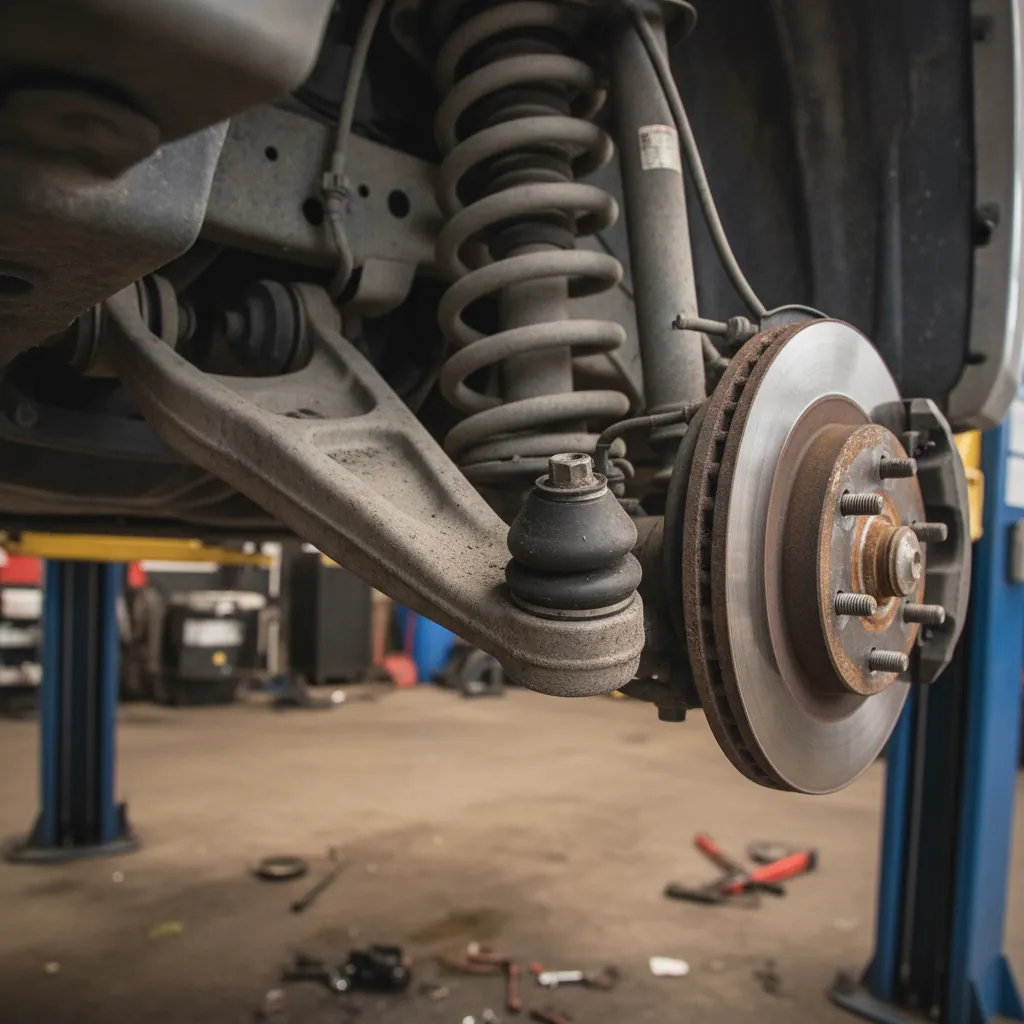
Your front wheels have to do two things at once. They have to move up and down as the suspension works, and they have to turn left and right when you steer. Something has to allow both at the same time without letting the wheel wander on its own.
Ball joints are that something. Each one is a ball and socket, much like your hip joint, connecting the control arm to the steering knuckle. It pivots in every direction while holding the wheel exactly where it belongs. It is packed with grease and sealed behind a rubber boot.
Tie rod ends are the steering side of the same idea. They connect the steering gear to the knuckle so that turning the wheel actually turns the tire. They are also ball and socket joints with the same kind of boot, and they set the toe angle, which is one of the main things a wheel alignment adjusts.

Both are wear items. Not in the sense that they fail on a schedule, but in the sense that they are joints under load and they do not last forever. When they get loose, the front end develops slop it did not have when it was new, and everything you feel through the steering wheel gets a little less honest.
The Symptoms, and What Each One Is Telling You
Here is how these actually show up, roughly in the order most owners notice them.
A clunk or a knock over bumps. The classic one. A loose joint has room to move before it takes up load, and that take up is the noise. It is worst over sharp inputs: a pothole edge, a railway crossing, the lip at the end of a driveway. It often shows up on washboard first because washboard is a rapid series of small impacts.
Wandering or vague steering. Slop in the joints means a small amount of steering input does nothing at all. On the highway the truck feels like it needs constant small corrections and it follows ruts and road crown more than it used to. People usually describe this as the truck feeling loose or tired rather than broken.
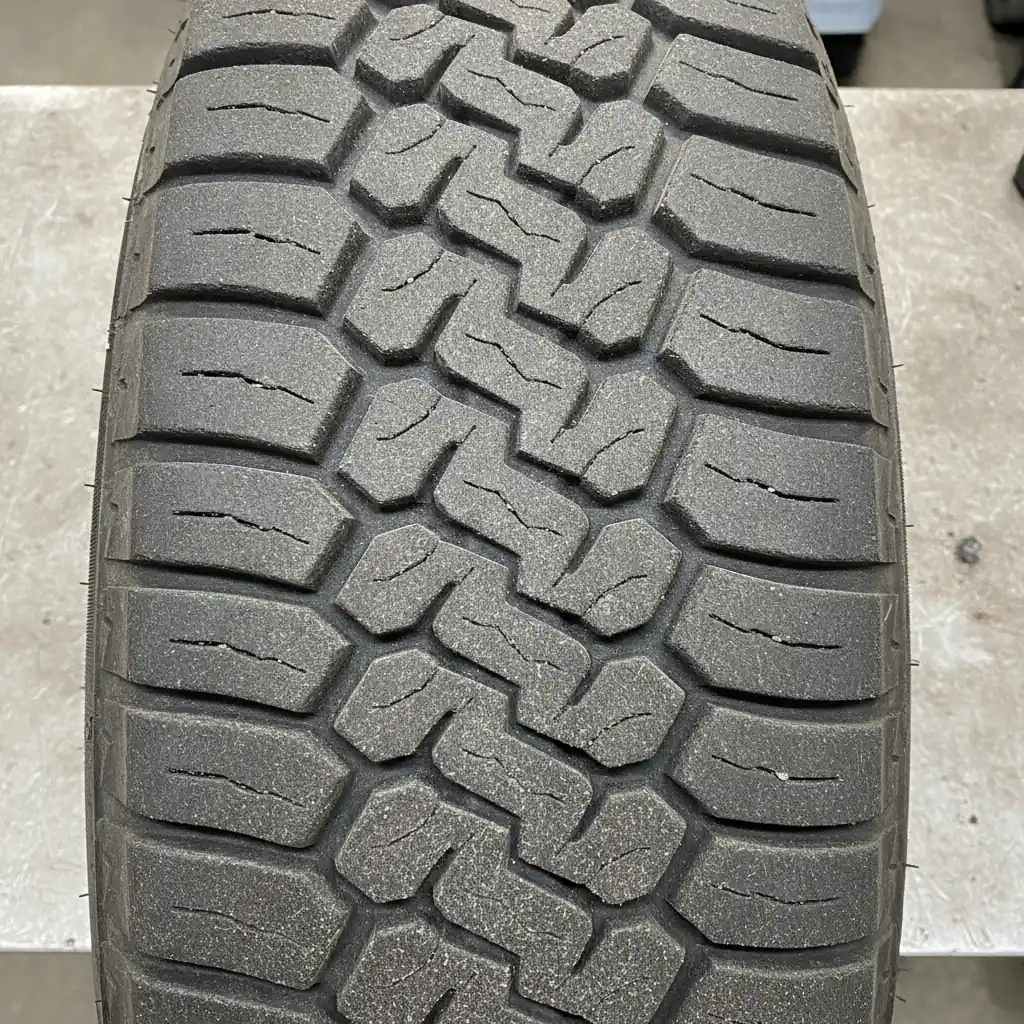
Uneven tire wear. When toe is off because a tie rod end is worn, the tire is being dragged slightly sideways every kilometre. That leaves a distinctive feathered or one sided wear pattern on the front tires. Our post on when to replace truck tires covers reading the wear patterns, and this one is worth learning because it costs you tires quietly.
A shimmy or vibration in the steering wheel. Can be several things, including balance and brake related issues, but front end play belongs on the list.
Squeaking or creaking at low speed. Often a boot that has failed and a joint that is now running short on grease. This is an early warning, and it is the cheapest moment to deal with any of this.
Steering wheel off centre after nothing in particular happened. Sometimes the first honest sign that something in the steering linkage has shifted.
One important caveat. Several of these overlap with other worn components. A clunk can be a sway bar link. Vague steering can be worn shocks. Uneven wear can be a plain alignment issue. That is exactly why the answer is an inspection on a hoist rather than a self diagnosis from a symptom list, including this one. Our post on when to replace shocks on a truck covers the ride control side of the same complaint, and wheel alignment in Manitoba covers the geometry side.
Why Gravel Roads Are Harder On This Than Anything Else

A truck that spends its life on pavement and a truck that runs section roads every day are not aging at the same rate, and the front end is where you see it first.
Washboard is a vibration machine. A corrugated gravel surface is a continuous rapid series of small impacts, and rapid small impacts are exactly the loading that finds play in a joint and makes it worse. A single pothole is one event. A kilometre of washboard is thousands.
Dust is an abrasive. Fine gravel dust gets everywhere, and if a boot has even a small split it gets into the joint. Once grit is inside a lubricated joint, wear accelerates and it does not stop.
Stone strikes take out boots. Loose stone thrown up by your own tires and by the truck ahead of you hits the underside constantly. A boot is rubber. It loses that argument eventually.
Then winter piles on. Road salt and brine work on everything under there, and the spring thaw hands you the worst potholes of the year right when the frost is coming out of the roads. That is the combination out here: an abrasive nine months and a corrosive several, on the same parts.
None of that means a prairie truck is a fragile truck. It means the front end is a maintenance area on a gravel road truck the way brakes are a maintenance area on a truck that tows. Expect to look at it, and it will not surprise you.
Getting It Checked, and What That Involves
There is no interval to quote here, and we are not going to invent one.
Ball joints and tie rod ends are checked, not scheduled. The vehicle goes on a hoist, the technician loads and unloads the joint to see how much movement there is, and that movement is compared against the manufacturer specification for your specific vehicle. Some designs allow a small amount of movement by design. Others allow essentially none. The specification is what decides it, which is why a number over the phone is worthless and a look on a hoist takes very little time.
A few practical points that come up constantly in our bays:
Replace in a sensible group, not one at a time. If joints on one side are worn from the same conditions, the ones beside them have lived the same life. Your technician should tell you honestly what is worn now and what is close, so you can decide once instead of paying for the same labour twice.
Plan on an alignment. Replacing a tie rod end changes toe, so an alignment afterward is not an upsell, it is part of doing the job. Skipping it wears the new parts and a set of tires.
Ask about the boots specifically. A joint with a fresh split boot is not worn out yet, but it is on the clock. Catching it there is the cheapest version of this entire article.
Bring the VIN for parts. Front end components vary by configuration, and the parts department works from the VIN rather than from the year and trim name.
If you are buying a used truck that clearly lived on gravel, this is one of the first things worth checking before you buy rather than after. In Manitoba a Certificate of Inspection is required as part of the registration process when a vehicle changes hands, and the standards it is measured against are set out in the province's Vehicle Equipment, Safety and Inspection Regulation. In our experience, worn steering and suspension parts are one of the common reasons a used truck does not pass on the first try, so it is worth knowing before you own it. Every truck on our used lot goes across a hoist on the way in for exactly that reason.
When It Stops Being a Noise and Becomes a Safety Item
Most worn front end parts give you a long, noisy warning period. That is the normal case, and it is why this usually ends as a planned repair rather than a bad day.
The reason we still treat it seriously is the failure mode at the end. If a ball joint separates, the control arm and the steering knuckle come apart, the wheel folds under the vehicle, and you are stopped wherever that happens. At highway speed with a trailer behind you, that is a genuinely serious situation, and out here plenty of the driving that finds worn front ends is exactly that: loaded, at speed, a long way from town.
So the rule we give customers is simple. A new clunk in the front end is worth getting looked at, not worth living with for a season. It is a short inspection, and the answer is usually either "that is a sway bar link, easy" or "here is what is worn and here is how long you have." Either answer is better than wondering.
Book it through our service department, or read up on how our service centre works if you have not been in before. If your truck is far enough down the road that you are weighing repairs against replacing it, we will give you that math honestly too, and you can see what is on the new Ram 1500 lot while you think about it.
FAQs
What are the symptoms of a bad ball joint on a truck?
The common ones are a clunk or knock from the front end over bumps and potholes, wandering or vague steering, uneven front tire wear, a shimmy through the steering wheel, and squeaking at low speed. Several of these overlap with other worn parts, so an inspection on a hoist is what confirms it.
Can you drive with a bad ball joint?
It depends entirely on how worn it is, which is why it needs to be measured rather than guessed. A joint with slight play is usually a planned repair. A badly worn one is not something to keep driving on, because a separated ball joint means the wheel folds and the vehicle stops moving where it stands. Get it looked at before you decide.
How do I tell a ball joint from a tie rod end?
By what the symptom does. Ball joint wear typically shows up as clunking over bumps, because the joint is carrying suspension load. Tie rod end wear typically shows up in the steering feel and in toe related tire wear. In practice a technician confirms which by loading each joint separately on a hoist.
How often should ball joints be replaced on a truck?
There is no kilometre interval. They are inspected and measured against the manufacturer specification for that vehicle, and they are replaced when the play exceeds it or the boot has failed. A truck that runs gravel roads will generally get there sooner than one that does not.
Do gravel roads really wear out front end parts faster?
Yes. Washboard is a continuous series of small impacts, gravel dust is abrasive and gets into any joint with a compromised boot, and thrown stone damages boots in the first place. Add prairie winters and spring potholes and the front end simply does more work out here.
Do I need an alignment after ball joints or tie rod ends?
After tie rod ends, yes, because replacing them changes the toe setting. After ball joints it is often needed as well depending on the design and what was disturbed. Skipping it wears the new parts and your front tires.
The Bottom Line
Front end wear is the tax a prairie truck pays for the roads it works on. Washboard, dust, stone and salt find the joints, and the truck tells you about it in three predictable ways: a clunk over bumps, steering that has gone vague, and tires wearing unevenly on the front.
None of that has to become a problem. It only becomes one when the noise gets ignored for a couple of seasons. If your truck has picked up a new clunk this summer, bring it in and we will put it on a hoist and tell you exactly what is worn, what is close, and what can wait.
Tyler Dunn, Dunn Ram Trucks, Portage la Prairie