You let go of the wheel for a second on a flat stretch of the Trans Canada and the truck wanders right. Or you notice the steering wheel logo sits a few degrees off centre while you are going dead straight. Or you crouch down at the front tire and feel a sharp edge on the tread blocks that was not there in the spring. Those are three of the most common reasons people call our service desk, and all three point at the same thing. If any of that sounds like your truck, the fastest path to an answer is to book a service appointment with us and have the alignment measured rather than guessed at.
Here is the honest local version of the alignment conversation. What our roads actually do to a truck, what the signs mean, what a technician is really adjusting, and when it is worth checking versus when you are fine to keep driving.
Key Takeaways
- Manitoba roads are hard on alignment, and the province's own numbers back it up. In CAA Manitoba's 2026 Worst Roads survey, 45 percent of drivers reported vehicle damage from poor road conditions, with potholes responsible for 86 percent of those cases. The average repair bill was $944, up from $882 the year before.
- Alignment is three angles: camber, caster and toe. Camber is the inward or outward tilt of the wheel seen from the front. Caster is the tilt of the steering axis seen from the side. Toe is whether the tires point in or out when viewed from above.
- Toe is the tire killer. A toe setting that is out of spec drags the tire sideways as it rolls, which shows up as feathered tread and eats a set far faster than most owners expect.
- The four signs to act on: the truck pulls to one side on a level road, the steering wheel sits off centre going straight, the tires wear unevenly across the tread, or the steering feels loose and darty after a hard hit.
- There is no single magic interval. Your Ram maintenance schedule calls for inspecting the front suspension and tie rod ends for wear and looseness, and for rotating tires at the first sign of irregular wear. Let the symptoms and the tire wear drive the decision.
What Manitoba Roads Actually Do to a Truck

Alignment does not usually drift on its own. Something moves it, and out here there is no shortage of candidates.

Gravel washboard. Every rural road in this part of the province develops those corrugated ripples through the summer, and a loaded truck at highway speed on washboard is taking thousands of small impacts a minute through the front end. That constant hammering is not what knocks a specific angle out on its own. What it does is wear the parts that hold the angles in place, the ball joints, the tie rod ends, the control arm bushings. Once one of those has play in it, the alignment cannot stay where it was set.
Spring frost heave and the thaw. Manitoba's 2026 spring road restrictions ran from March 20 through to late May in most zones, and out to June 10 in Zone 5. Those restrictions exist because the roadbed goes soft as it thaws. Soft roadbed plus heavy traffic equals broken edges, sunken shoulders and the pothole crop we all know. That is the season when a single hard hit will change your toe setting in an instant.
The potholes themselves. CAA Manitoba's 2026 campaign collected 711 road nominations across 69 municipalities, and named Provincial Trunk Highway 34 the worst road in the province for the second year running. PTH 34 crosses the Trans Canada at Austin, which is a short drive west of our shop, so this is not somebody else's problem for our customers. Three quarters of the drivers who reported damage in that survey paid for the repair themselves.

Field approaches, ditch edges and curbs. Dropping a front wheel off a gravel approach, clipping a curb in a Winnipeg parking lot, or backing a trailer over a rough field edge is exactly the kind of sudden sideways load that moves a wheel out of spec.
The Signs Your Truck Is Out of Alignment
The truck pulls. On a flat, level road with no crown and no crosswind, a truck that is in spec should track straight with light hands on the wheel. If you are holding steady pressure to one side to keep it in the lane, something is asking to be looked at. Be fair about the test though. Prairie highway crown and a stiff west wind will both pull a truck, so judge it on a road you know.
The steering wheel is off centre. This one is the cleanest tell of all. If you are driving perfectly straight and the wheel is cocked ten or fifteen degrees, the toe on that axle is not where it should be. It is also the sign people live with the longest, because the truck still drives fine and you stop noticing it after a week.
The tires are wearing unevenly. Run your hand across the tread. If one shoulder is noticeably lower than the other, that points at camber. If the tread blocks feel smooth in one direction and sharp in the other, that feathering points at toe. Both are worth catching early because that rubber is not coming back. It is worth reading our guide on how often to rotate tires in Manitoba alongside this one, because rotation and alignment are the two habits that decide whether you get the life you paid for out of a set.
The steering feels vague or darty. Loose or wandering steering after a big hit is often a caster issue, or a worn steering component that will need replacing before an alignment will even hold.
One honest caution. A vibration is usually not alignment. Shaking through the wheel at highway speed is far more often a balance issue or a bent rim.
What an Alignment Actually Includes
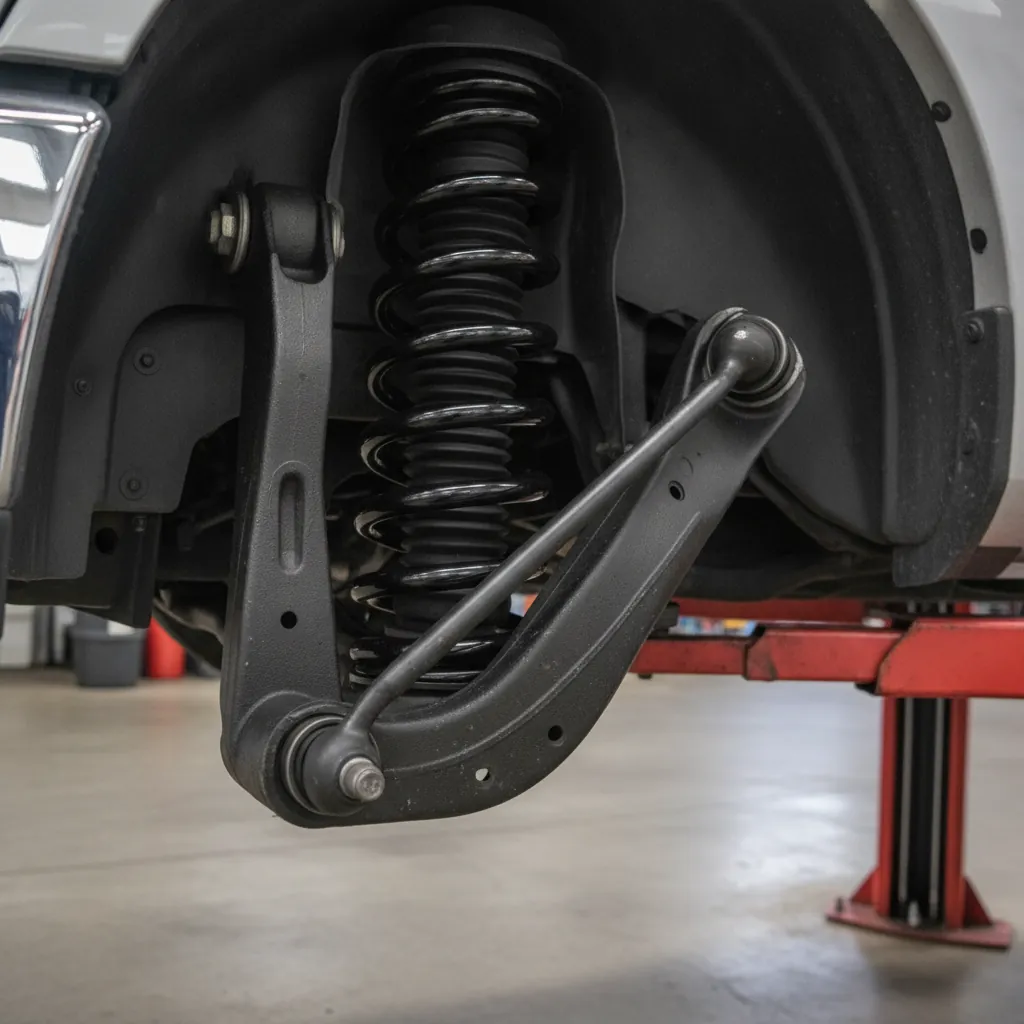
A technician is not bending anything straight. They are measuring and correcting three angles against the factory specification for your exact vehicle.
Camber is the inward or outward tilt of the top of the wheel when you look at the truck from the front. Tilt the top inward and that is negative camber. Tilt it outward and that is positive. Too much either way and the tire stops sitting flat on the road, so one edge of the tread carries the load and wears out first.
Caster is the tilt of the steering axis when you look at the truck from the side. It is the angle that gives you straight line stability and makes the wheel come back to centre after a corner. Caster does not wear tires the way toe and camber do, but it is what makes a truck feel planted or feel nervous.
Toe is whether the tires point slightly toward each other or slightly away when you look down from above. Toe in means the fronts point together, toe out means they point apart. Get toe wrong and every kilometre you drive is scrubbing rubber off sideways. This is the angle that quietly destroys tires.
You will also hear two wheel versus four wheel alignment. A two wheel alignment sets the front axle only. A four wheel alignment measures all four corners and squares the front to the rear thrust line. Which one your truck needs depends on its suspension and on what the measurement shows, and the service advisor will tell you which one applies before any work starts. Our service centre works to the factory specification for your VIN, not a generic setting.
When to Get It Checked
We are not going to print a hard interval we cannot stand behind, because the honest answer depends on your roads and your kilometres. Here is how we actually think about it.
Check it after a real impact. A pothole hit hard enough to make you wince, a curb strike, or dropping a wheel off an approach. Do not wait for the tires to tell you.
Check it when you buy tires. Putting a fresh set on a truck that is out of spec is the most expensive way to find out. Any time new rubber goes on is the natural moment to measure.
Check it at the end of pothole season. Late spring, once the thaw damage has been driven on for a few weeks, is the highest yield time of year to have it looked at in this province.
Check it if any of the four signs are present. Pull, off centre wheel, uneven wear, vague steering. One sign is enough to book it.
Otherwise, fold it into a service visit. Tire manufacturers such as Bridgestone commonly suggest having tires aligned and balanced around every 8,000 to 10,000 kilometres, which lines up neatly with a rotation. That is a tire industry guideline rather than a Ram requirement, so use it as a prompt to have it checked, not as a reason to pay for an adjustment you do not need. For the full picture of what your truck is due for and when, our Ram 1500 maintenance schedule breakdown lays it out.
One thing worth saying plainly. A truck with worn steering or suspension parts cannot hold an alignment, so a good shop will inspect the front end first and tell you if a tie rod end or ball joint needs replacing before the adjustment. If someone aligns a truck with a loose front end and says nothing, you have paid for something that will not last the summer. We stock the genuine Mopar pieces through our parts department when a component does need to come out.
How the Visit Works Here
Book online or call, tell us what you are noticing and roughly how long it has been going on, and mention any big hit you remember. We measure all the angles against the factory spec for your VIN and show you the before numbers. If the truck is in spec, we tell you that and you have your answer. If it is out, you get the numbers and a straight recommendation, including anything worn that has to be dealt with first. Pricing depends on whether it is a two wheel or four wheel job and on what the inspection turns up, so ask the advisor for the number on your truck rather than a figure you saw online. For the wider tour of how our shop runs, we wrote that up in our guide to the Dunn service department.
FAQs
How do I know if my truck needs a wheel alignment?
Four signs. The truck pulls to one side on a flat, level road with no wind. The steering wheel sits off centre while you are driving straight. The tires are wearing unevenly across the tread, either on one shoulder or feathered across the blocks. Or the steering feels loose and wandering after a hard impact. Any one of those is reason enough to have it measured.
What does a wheel alignment actually adjust?
Three angles, measured against the factory specification for your vehicle. Camber is the inward or outward tilt of the wheel viewed from the front. Caster is the tilt of the steering axis viewed from the side, which controls straight line stability. Toe is whether the tires point inward or outward viewed from above, and it is the angle with the biggest effect on tire wear.
How often should I get an alignment in Manitoba?
There is no fixed interval printed for it. The practical rule out here is to have it checked after any hard pothole or curb hit, whenever you buy tires, at the end of spring pothole season, and any time you notice one of the warning signs. Tire makers commonly suggest checking alignment and balance around every 8,000 to 10,000 kilometres, which folds neatly into a rotation visit.
Do gravel roads cause alignment problems?
Indirectly, and it is the more common story out here than people realize. Washboard corrugation does not usually shift an angle in one go. What it does is wear out the ball joints, tie rod ends and bushings that hold those angles in place, and once a component has play in it the alignment will not stay set. Loose stone and rough approaches also produce the sudden sideways hits that move toe immediately.
Is a vibration at highway speed an alignment problem?
Usually not. A shake through the steering wheel or the seat at highway speed is far more often a wheel balance issue, a bent rim, or a tire with a belt problem. Alignment shows up as pulling, off centre steering and uneven wear rather than shaking. A good inspection will separate the two.
The Bottom Line
Alignment is one of the cheapest ways to protect one of the more expensive things you buy for your truck. Our roads, our thaw and our gravel guarantee that a truck up here will drift out of spec eventually, and the cost of ignoring it is a set of tires wearing out early plus a truck that never quite feels right in your hands.
If the wheel is off centre, if it pulls, or if you felt a pothole hit that you are still thinking about, book it in with our service department and we will measure it and give you the numbers. And if the tires and the front end have both gotten to the point where the repair math stops making sense, we will tell you that too, and you can look at what a trade toward a newer Ram 1500 is worth with an instant cash offer on your current truck.
Tyler Dunn, Dunn Ram Trucks, Portage la Prairie