Every fall our parts counter gets the same question, usually on a Saturday, usually from someone holding two jugs of oil and a receipt. Which one goes in my Ram 1500. The honest answer is that it depends on which engine is under the hood, and the Ram 1500 has been sold with several of them. The right oil for one can be the wrong oil for the next.
If you would rather skip the guesswork, book an oil change with our service department and we will put in what the engine was built for, or stop by our parts department and we will match the oil and filter to your VIN. If you want to understand it yourself first, here is the straight version, engine by engine.
Key Takeaways
- The engine decides the oil, not the truck. A Ram 1500 with the 3.6 litre V6 eTorque, the 5.7 litre HEMI V8, the Hurricane Standard Output or the Hurricane High Output can each call for something different.
- The Hurricane High Output is the one to get right. The Standard Output Hurricane runs 0W20 full synthetic. The High Output Hurricane calls for 0W40 full synthetic. They are not interchangeable.
- Newer HEMI trucks call for 0W20, older ones for 5W20. The grade printed on the oil fill cap of your engine settles the question for your truck.
- The viscosity is only half the label. The owner manual also names a Chrysler material standard. The right bottle carries both.
- Capacity is a fill, then a check. Use the with filter capacity in your owner manual for your model year and engine, then confirm on the dipstick. Overfilling is its own problem.
- In a prairie cold snap, thinner is protection. A 0W oil flows faster at a cold start, which is when most engine wear happens.
First, Know Which Engine You Have
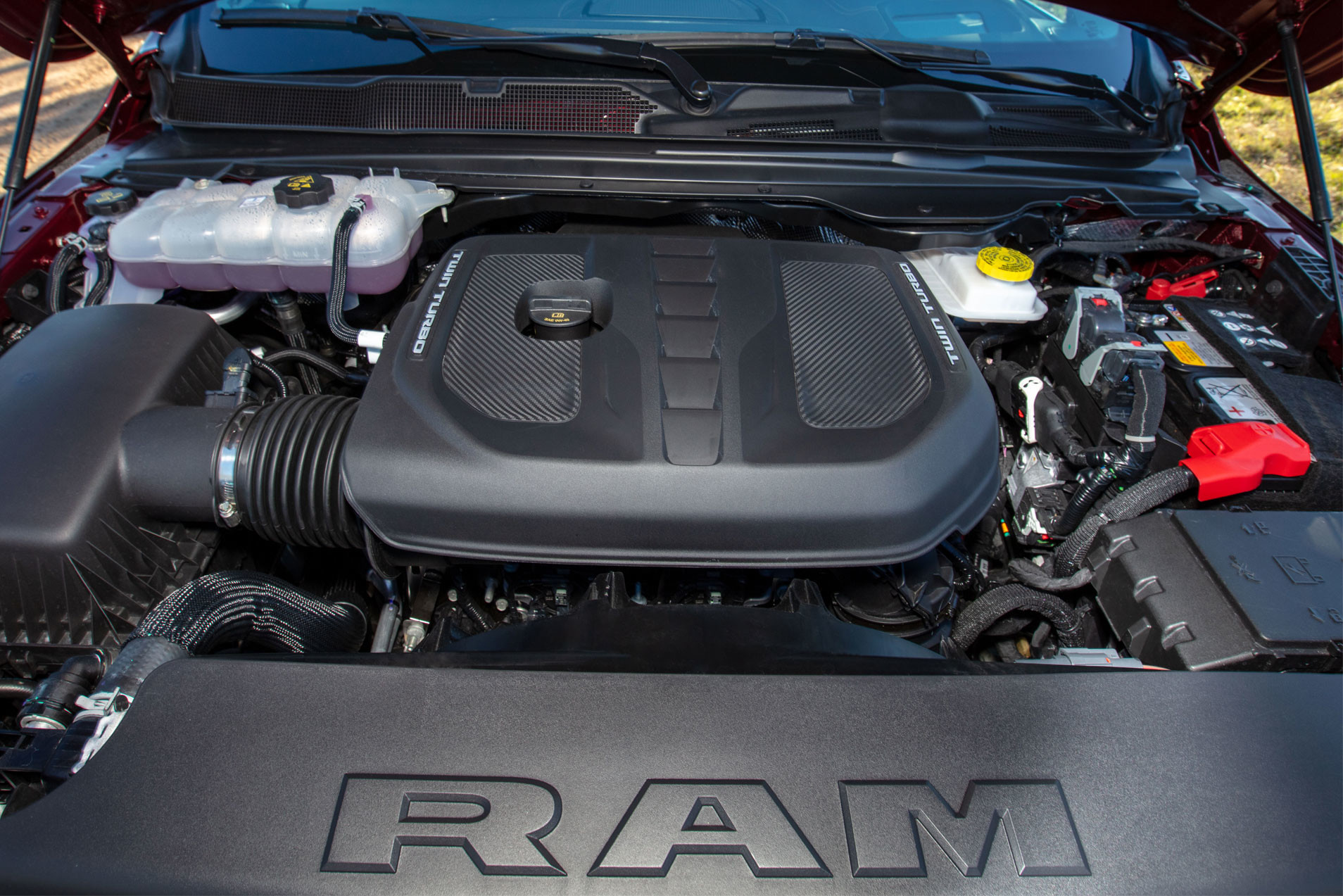
Before the oil question comes the engine question, and it is easier to answer than people think.

Look at the oil fill cap. On a modern Ram engine the viscosity grade is marked on the cap under the hood. That is the fastest and most reliable answer you will get, because it came from the factory with the engine.
Check the window sticker or the build sheet. If you still have the paperwork from the purchase, the engine is listed.
Ask us with the VIN. Our parts and service teams can decode the engine from the VIN in a minute, which also covers a used truck bought privately with no paperwork at all.

The four gas engines you are most likely to find in a Ram 1500 from recent years are the 3.6 litre Pentastar V6 with eTorque, the 5.7 litre HEMI V8 with eTorque, and the 3.0 litre Hurricane twin turbo inline six in two versions, Standard Output and High Output. If you want the background on the Hurricane itself, our post on the Ram Hurricane engine explains how the two outputs differ.
Ram 1500 Oil Type by Engine

Here is what each engine calls for. Treat this as the map, and your fill cap and owner manual as the final word for your exact truck.
3.6 litre Pentastar V6 with eTorque. 0W20 full synthetic.
5.7 litre HEMI V8 with eTorque. Newer HEMI trucks call for 0W20 full synthetic. Older HEMI trucks were specified 5W20. If you have an older HEMI and you are not sure which side of that change it falls on, the grade on your fill cap is the answer.
3.0 litre Hurricane Standard Output. 0W20 full synthetic.
3.0 litre Hurricane High Output. 0W40 full synthetic. This is the one we see mixed up most often, because it shares a displacement and a name with the Standard Output engine. The High Output makes more power and runs hotter, and it is built around a heavier grade. Do not put 0W20 in a High Output Hurricane to match your buddy's truck.
Read the rest of the label. Beside the viscosity grade, the owner manual names a Chrysler material standard the oil must meet. A bottle can say the right grade and still not carry the right approval. When in doubt, bring the bottle to our counter and we will tell you.
What About Capacity
This is the half of the question where we are going to be careful, and here is why. When we checked the published capacity figures for the Ram 1500 engines, the sources did not all agree, and on at least one engine they differed by close to a litre. We are not going to print a number on this page that could have you overfill or underfill your truck.
What we can tell you is how to get it right every time.
Use the with filter figure for your model year and engine. Your owner manual has a fluid capacities table. Use the number for an oil change that includes a new filter, because the filter holds oil too.
Fill a little short, run it, then check. Add most of the oil, start the engine for a short run so the filter fills, shut it off, wait a few minutes, and read the dipstick on level ground. Top up to the full mark from there.
Do not overfill. Too much oil can be churned by the crankshaft and aerate, which is not the extra protection some people think it is.
Our techs work from the service information for your exact truck, which is one reason a dealer oil change takes the guessing out of it. The service centre page walks through what else gets looked at while the truck is on the hoist.
Why 0W20 and 5W20 Are Not the Same Oil

The two numbers on a bottle of oil describe two different conditions.
The first number, with the W, is the cold rating. The W stands for winter. A lower number means the oil flows more easily when the engine is cold. A 0W oil moves faster at a cold start than a 5W oil.
The second number is the rating at operating temperature. Both 0W20 and 5W20 behave as a 20 grade once the engine is warm.
So the difference between them lives almost entirely in the first minutes after a cold start. That sounds small until you remember where engine wear actually happens. A modern engine is built with tight clearances and uses oil pressure to do real work, such as moving the variable valve timing. An engine designed for 0W20 expects oil to arrive quickly when it is cold. Swapping to a grade the engine was not built for is not an upgrade.
What a Manitoba Cold Snap Does to a Heavier Grade
Out here this is not a theory question. On a January morning at minus 30, oil in the pan is thick, and the thicker the grade, the longer it takes to reach the top of the engine after you turn the key.
We still hear the old advice to run a heavier oil in winter for more protection. On a modern Ram engine it works the other way around. The protection at a cold start comes from oil that flows. That is exactly why these engines are specified with 0W oils, and why the High Output Hurricane still uses a 0W grade even though it runs a heavier hot rating.
Two habits make a bigger difference than any oil swap. Plug in the block heater on the cold nights, because a warm engine block means warm oil at startup, and our block heater guide for Manitoba covers when and how long. And stay on full synthetic, which holds up far better in the cold than conventional oil. Our comparison of synthetic versus conventional oil in the Ram 1500 goes deeper on that.
When to Change It

The Ram 1500 uses an oil change indicator that watches how the truck is actually driven, and the owner manual sets a maximum time and distance the oil should never go past, whichever comes first. Short winter trips, idling to warm up, towing and gravel dust all count as hard use, and many prairie trucks live that way from November to March.
If you want a shop that does it right and knows these engines, our oil change service in Portage la Prairie explains what is included.
FAQs
What type of oil does a Ram 1500 take?
It depends on the engine. The 3.6 litre V6 eTorque and the Hurricane Standard Output take 0W20 full synthetic. The Hurricane High Output takes 0W40 full synthetic. Newer 5.7 litre HEMI trucks take 0W20, and older HEMI trucks were specified 5W20. The grade on your oil fill cap confirms it.
How much oil does a Ram 1500 hold?
It varies by engine and model year, and published figures do not always agree. Use the with filter capacity in your owner manual, fill slightly short, run the engine briefly, then top up to the full mark on the dipstick. We can confirm the figure for your VIN.
Can I use 5W20 instead of 0W20 in my Ram 1500?
Use the grade your engine calls for. An engine designed for 0W20 expects the faster flow at a cold start, and that matters most in a Manitoba winter.
Does the Hurricane High Output use different oil?
Yes. The Standard Output Hurricane uses 0W20 full synthetic and the High Output uses 0W40 full synthetic. Check the fill cap and the owner manual before you buy oil.
Should I use thicker oil in winter?
No. On a modern Ram engine, the thinner cold rating of a 0W oil is what protects the engine at a cold start. Plug in the block heater and stay with the specified grade.
The Bottom Line
The right oil for a Ram 1500 comes down to one fact, which engine you have. Read the fill cap, match the grade and the material standard, use the with filter capacity for your model year, and check the dipstick instead of trusting the jug. Keep the High Output Hurricane on its 0W40, and do not reach for a heavier oil when the temperature drops.
If you would rather hand it off, book your Ram 1500 in with our service department and we will handle it, or grab the right oil and filter from our parts department. And if you are shopping for your next truck, our new Ram 1500 inventory shows which engines are on the lot right now.