

The winter set comes off the rack in October, goes on the truck, and somebody asks the question we hear more than any other at changeover. Are these still good for another year? The tread blocks look fine. The tires are not that old. And yet the truck felt a little loose on the Trans Canada last February, and you are not sure whether that was the road or the rubber.
A winter tire does not wear out the way an all season does. It stops being a winter tire well before it is legally finished, and the calendar, the road and the summer all get a vote in when that happens. Here is how to tell, in seasons and in millimetres. The quickest answer for your own set is to book the changeover and have us measure all four while they are on the hoist.
Key Takeaways
- A winter set commonly lasts three to five Manitoba seasons. Kilometres, gravel, bare pavement and how the set is stored decide which end of that range you land on.
- A winter tire stops working as a winter tire around 4.8 millimetres of tread. Quebec's government recommends at least that much in winter, well above the 1.6 millimetre legal minimum.
- Age counts even when tread does not. The winter compound hardens over time, so an old set with deep tread can still be a poor winter tire.
- Summer driving is the fastest way to ruin a set. Above about 7 degrees Celsius the soft compound wears quickly and stops noticeably worse than a summer or all season tire.
- Rotation and proper storage buy you another season. Both are cheap, and both are the difference between four winters and three.
Seasons: The Honest Range

Most sets we see at changeover land somewhere between three and five winters. That is a wide range, and the reason is that the distance a truck covers in a Manitoba winter varies enormously from one owner to the next.

What pushes a set toward five winters: mostly snow covered or city driving, moderate kilometres, prompt changeovers in both directions, rotation at the swap, and a cool dark place to spend the summer.
What pulls it toward three, or fewer: high highway kilometres on bare, dry, salted pavement, a lot of gravel, a heavy truck that tows through the winter, and a set that stayed on into May.
Gravel deserves its own mention, because it is the thing drivers in town never think about and drivers around Portage live with. A soft winter tread on a gravel grid road is being chipped and scrubbed every kilometre, and loose stone at speed tears at the edges of the tread blocks. We regularly see a set that ran rural gravel all winter looking a season older than an identical set that stayed on city streets.

Tread: Where a Winter Tire Stops Being One
MPI's driver's handbook tells Manitobans to replace a tire when the tread is below 1.6 millimetres, the same legal floor Quebec uses. That is the point where a tire is finished. It is not a winter number.
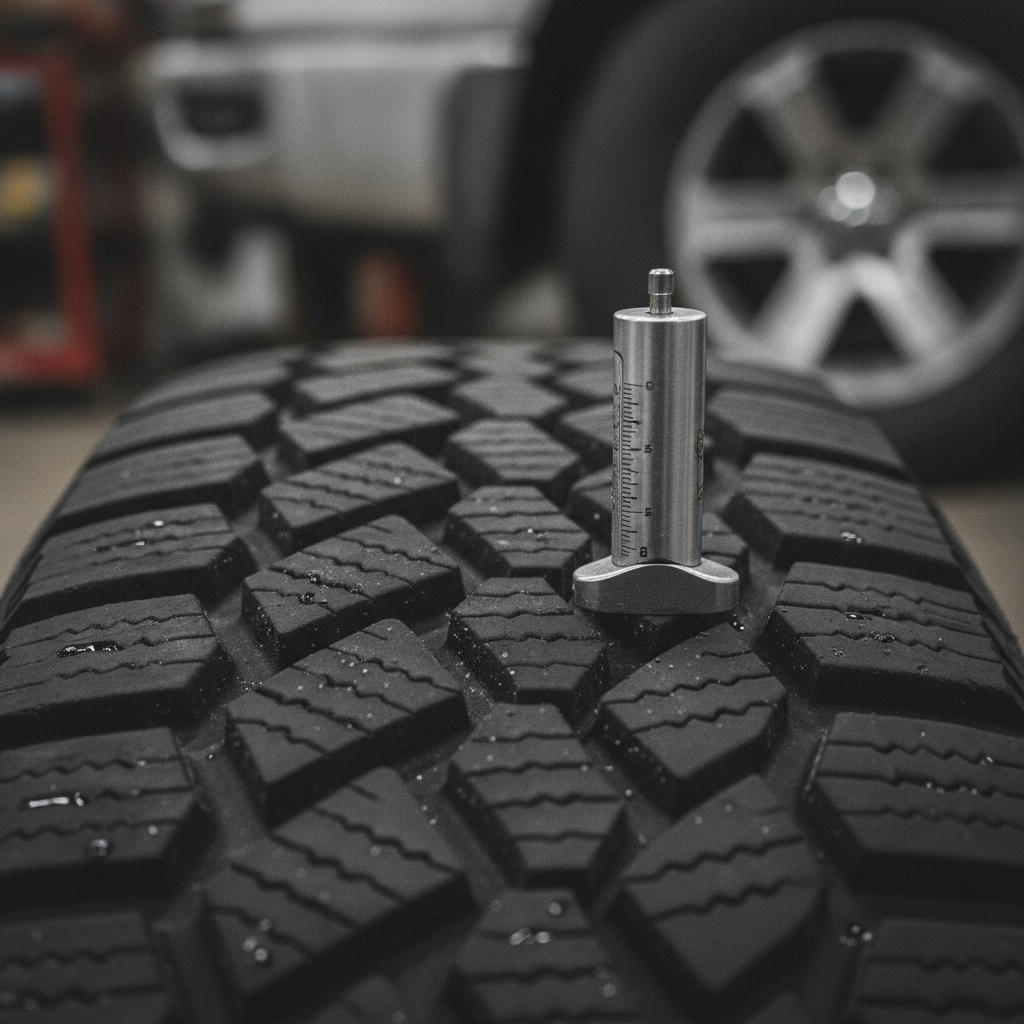
A winter tire grips snow by packing its grooves with snow and biting with hundreds of fine sipes. As the tread wears down, the grooves get too shallow to hold snow and the sipes, which are only cut so deep, start to disappear. Quebec's government, which mandates winter tires, recommends at least 4.8 millimetres of tread depth during the winter. That is the number we would use as the working line for a winter set here. Below it you have a tire that still looks like a winter tire and behaves more like a worn all season.
Many winter tires carry a second wear indicator moulded into the main grooves, set higher than the standard legal wear bar, to show when the tire is no longer good for winter. Not every tire has one, and a gauge is quicker than hunting for it. Our guide to when to replace truck tires walks through measuring all four, and the inside edge is the one people skip.
Age: The Clock That Runs in Storage Too
Tread tells you how much tire is left. Age tells you whether that tire still behaves like a winter tire.
A winter compound is formulated to stay soft in deep cold. It loses that softness gradually as it ages, whether the tires are on the truck or on a rack in the garage. An eight year old set with plenty of tread can feel noticeably more slippery than its depth suggests, because the rubber has hardened.
The build date is on the sidewall, as the last four digits of the DOT code: the week, then the year. Tire makers generally want tires professionally inspected from about five years old, and most put the outside limit around ten years from the build date regardless of tread. For a winter set, which leans on its compound more than any other tire, we would rather see it retired toward the front of that window than the back.
Why Summer Driving Kills Winter Tires

Every fall we see a few sets that never came off in April. They are easy to spot. The shoulders are feathered, the tread blocks have gone smooth and rounded at the edges, and the set that should have had two more winters in it has maybe one.
Three things are happening. The soft compound that grips at minus 25 wears quickly on hot pavement, the same way a pencil eraser wears on sandpaper. The tall, flexible, heavily siped tread blocks squirm under cornering and braking loads in the heat, which scrubs them down faster. And the tire does its worst job at exactly the moment it is wearing out fastest: on warm dry pavement a winter tire takes longer to stop and feels vague in a lane change compared with the tire it is standing in for.
Tire makers generally put the crossover around 7 degrees Celsius. Once daytime highs sit above that for good in the spring, the winter set is losing tread for no benefit. A few weeks either side of the date is not the issue. A whole summer is.
If you own studded tires, the calendar decides it for you. MPI's driver's handbook says studded tires are illegal between April 30 and October 1.
How to Stretch a Set to Its Fifth Winter
Rotate them at every changeover. The drive axle and the steering axle wear a set differently. Moving the tires front to back each fall evens that out so all four reach the end together instead of two being done a season early. We cover the pattern for trucks in how often to rotate tires in Manitoba.
Keep the pressure right. Cold air drops tire pressure steadily through the fall. An underinflated winter tire wears its shoulders and runs hotter than it should. Check them once a month through the season, on a cold tire.
Take them off on time in the spring. The single cheapest way to get another winter.
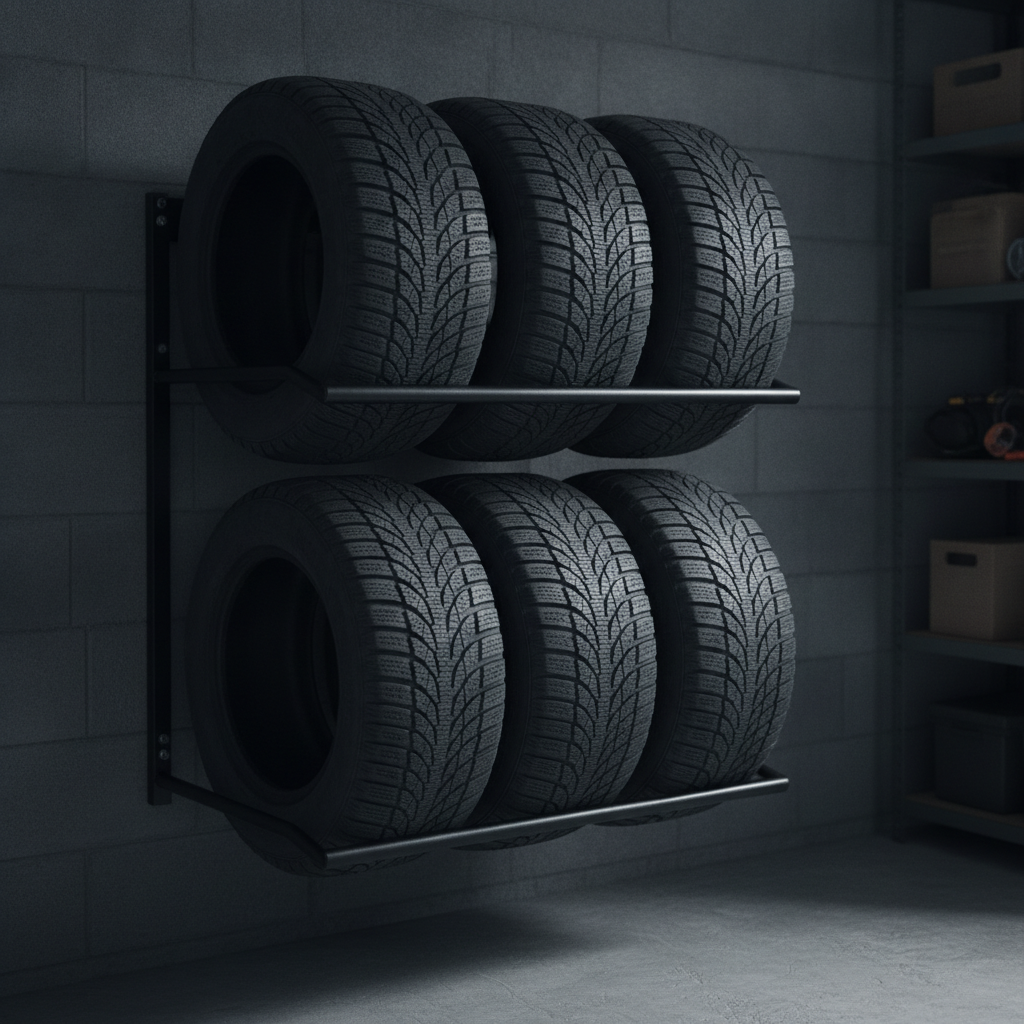
Store them properly. Clean them, dry them, and keep them out of sunlight and away from anything with an electric motor, which gives off ozone that ages rubber. A cool, dark corner beats a sunny garage wall. If you would rather we keep them, winter tire storage explains how that works.
Get the alignment checked if one edge is going faster. A set that wears one shoulder is telling you something about the truck, not the tires, and a new set will wear the same way unless it is fixed.
When It Is Time for a New Set
Replace the set when the tread is at or near 4.8 millimetres, when the tires are approaching ten years from their build date, or when there is damage no repair should be trusted with: a sidewall cut, a bulge, or a patch too near the shoulder. Replace all four together. Mixing a fresh pair with a worn pair on a four wheel drive truck gives you two different grip levels front and rear on ice, which is how a truck ends up facing the wrong way.
Our parts department will match a new set to the placard on your door jamb. If you are planning to finance through MPI's Winter Tire Program, we are a participating retailer, and our post on whether winter tires are required by law in Manitoba explains the October 1, 2026 rule on which tires qualify.
FAQs
How many years do winter tires last?
Commonly three to five Manitoba seasons, depending on kilometres, road surface, storage and whether they came off promptly each spring. Tire makers generally recommend a professional inspection from about five years old and put the outside limit around ten years from the build date.
How much tread do winter tires need?
The legal minimum is 1.6 millimetres, but that is the end of a tire's life, not a winter number. Quebec's government recommends at least 4.8 millimetres during winter, and that is a sensible line for replacing a winter set here.
Is it bad to drive on winter tires in the summer?
Yes. Above about 7 degrees Celsius the soft compound wears quickly, and on warm dry pavement a winter tire stops longer and handles less precisely than an all season or summer tire. A set run through a summer can lose a full winter of life.
Do winter tires go bad if they are not used?
They age even in storage. The compound slowly hardens, so a set with deep tread can still grip less than it should. Check the DOT date code and store them cool, dark and away from electric motors.
Should I replace all four winter tires at once?
Yes. On a four wheel drive truck, two fresh and two worn tires give you different grip front and rear on ice. Four matched tires wear evenly and stop predictably.
Can I tell if my winter tires are done just by looking?
Not reliably. Measure the tread depth in several grooves on each tire, read the DOT date, and look for feathered shoulders or sidewall damage. We measure all four at every changeover.
The Bottom Line
A good winter set gives most Manitoba drivers three to five winters, and the difference between the two ends of that range is mostly habit. Take them off in the spring, rotate them in the fall, keep them at the right pressure, and store them somewhere cool and dark. Retire them at 4.8 millimetres or as they approach ten years old, whichever comes first, rather than at the legal minimum.
The simplest way to know where your set stands is to let us measure it. Book the changeover for early October, before the first snow fills the calendar, and our service centre will check the depth, the dates and the wear pattern on all four. If the truck under them is ready for a change too, our new Ram 1500 inventory is online.
Tyler Dunn, Dunn Ram Trucks, Portage la Prairie

























