
It is the first real cold morning of the year. You plugged the truck in before bed, you can see the cord running to the house, and it still cranks slow and rough like it never had a heater at all. Something in that chain did not do its job overnight, and there are only three candidates: the outlet, the cord, or the element in the engine itself.
The good news is that you can narrow it down yourself in about ten minutes, and two of the three failures are inexpensive fixes. The one that is not is worth knowing about before December rather than during it, so if you want it confirmed properly you can book it into our service department now while the shop is not buried. Here is how to find out which one you have.
Key Takeaways
- There are only three failure points: the wall outlet, the cord assembly, and the heater element in the engine block. Test them in that order, because the first two are cheap and the third is not.
- The most common find out here is the cord, not the element. A chewed end from rodents, a cracked plug from being yanked at 30 below, or corroded pins in the block connector account for most of the block heaters we see fail.
- A working element reads as a complete circuit. A shop checks resistance across the element with a meter. If it reads open, meaning no continuity at all, the element itself has failed. A specific target resistance varies by engine, so match it to your service documentation rather than a number off a forum.
- The cheapest test needs no tools. Plug a lamp or a phone charger into the outlet you have been using. A surprising number of block heater complaints are a dead outdoor outlet or a tripped ground fault breaker, not a truck problem at all.
- A block heater is worth fixing on real numbers. Natural Resources Canada reports that at minus 20 a block heater can improve overall fuel economy by as much as 10 percent, and for a single short trip at minus 25 the savings could be in the order of 25 percent.
Step One: Prove the Outlet Is Live
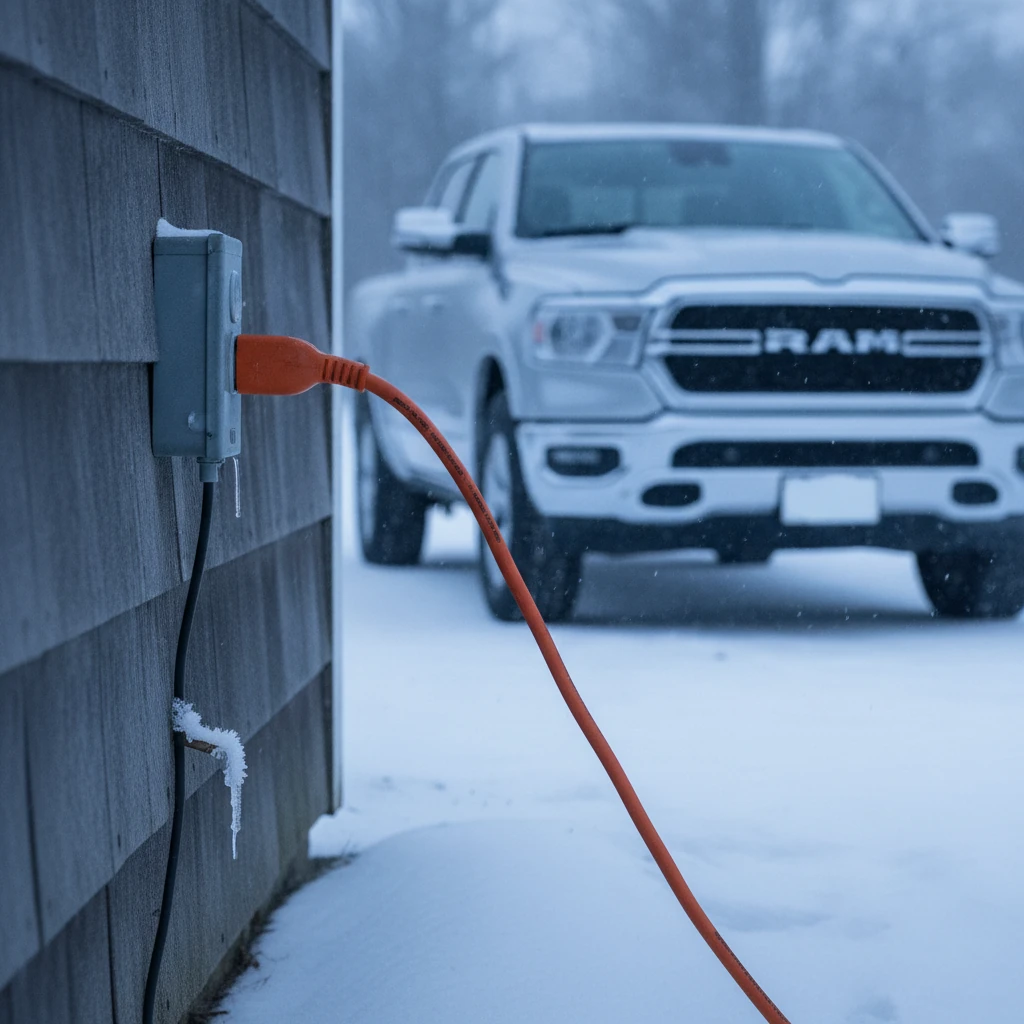
Start here, because it costs nothing and it is right about a quarter of the time.

Outdoor outlets are usually on a ground fault circuit. Ground fault breakers trip on moisture, and a plug sitting in a snowdrift through a thaw and refreeze is exactly what trips them. The breaker can be at the outlet itself as a small reset button, or back in the panel.
What to do: plug a work light, a phone charger or anything with an obvious on state into that outlet. If it is dead, press the reset on the outlet, and if there is none, check the panel. If the outlet works on the reset and trips again the next night, you have a moisture problem in the outlet or the cord, not an engine problem.
While you are there, look at your extension cord. A light indoor cord is not the right tool for this. It needs to be an outdoor rated cord heavy enough for a continuous heating load, and it needs to be in one piece. A cord with a repair wrapped in electrical tape sitting in the snow is a ground fault waiting to happen.

Step Two: Inspect the Truck Side Cord
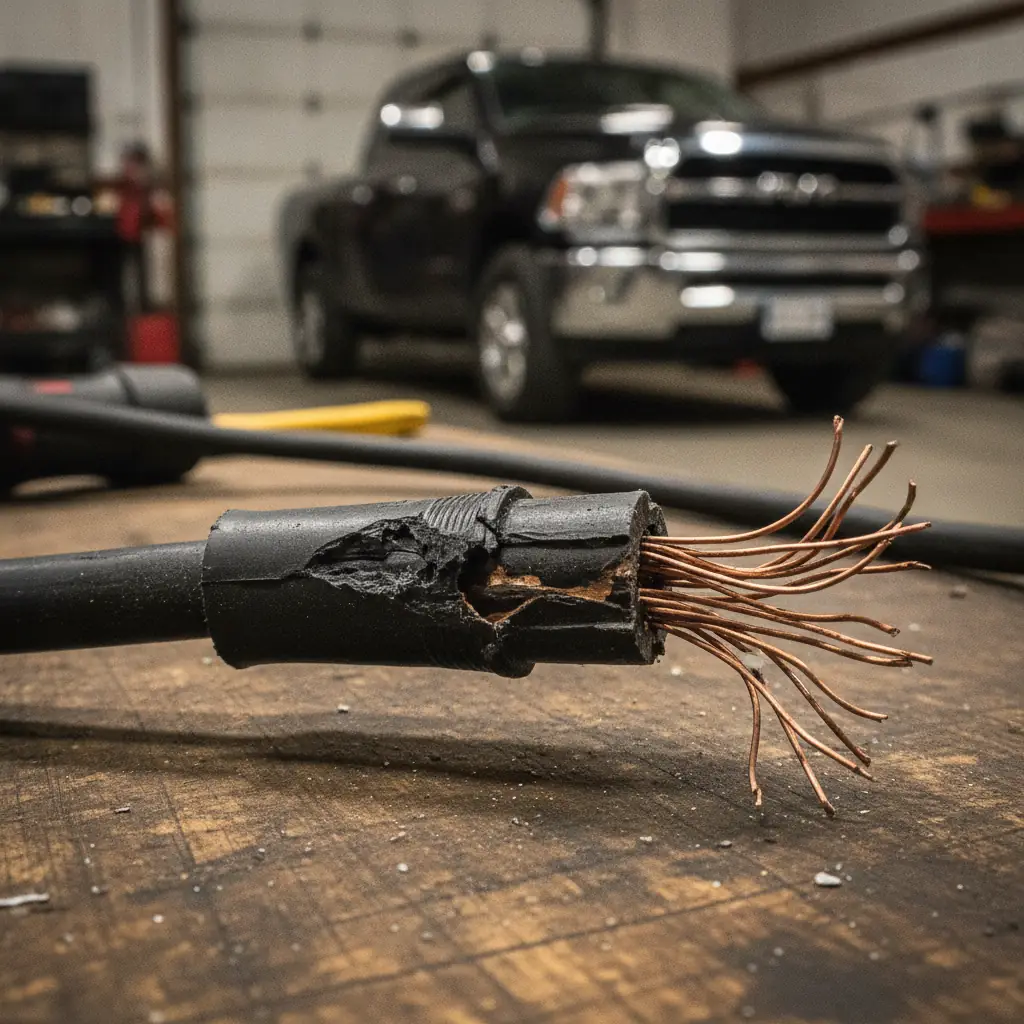
This is where most of them die, and it is the reason we tell people to actually look rather than assume.
Open the hood and follow the cord from wherever it hangs at the grille back to where it plugs into the engine block. You are looking for three things.
Chew damage. Mice and squirrels nest in a warm engine bay and they chew cord insulation. A truck that sits outside on an acreage or beside a bin yard is a prime candidate. This is the single most common thing we find, and it is often obvious the moment you look: missing insulation, exposed copper, or an end that has been gnawed square off.
Physical damage at the plug. The end that plugs into your extension cord takes abuse. People yank it apart when it is frozen, drive off with it still connected, or catch it on the bumper. Cracked housings and bent or missing pins are common.
Corrosion at the block connector. The end that plugs into the engine sits in road salt and slush all winter. Pull it apart and look at the pins. Green, white or crusty means a bad connection, and a bad connection means little or no current is reaching the element even though everything looks plugged in.
If any of those three are present, the cord assembly is your answer. It is a replaceable part, it is not expensive, and Mopar makes the correct one for your specific year and engine. The cords are year and engine specific, so it is worth having it matched by VIN rather than guessing at a parts counter. Our parts department can pull the right one up for you.
Step Three: Test the Element Itself
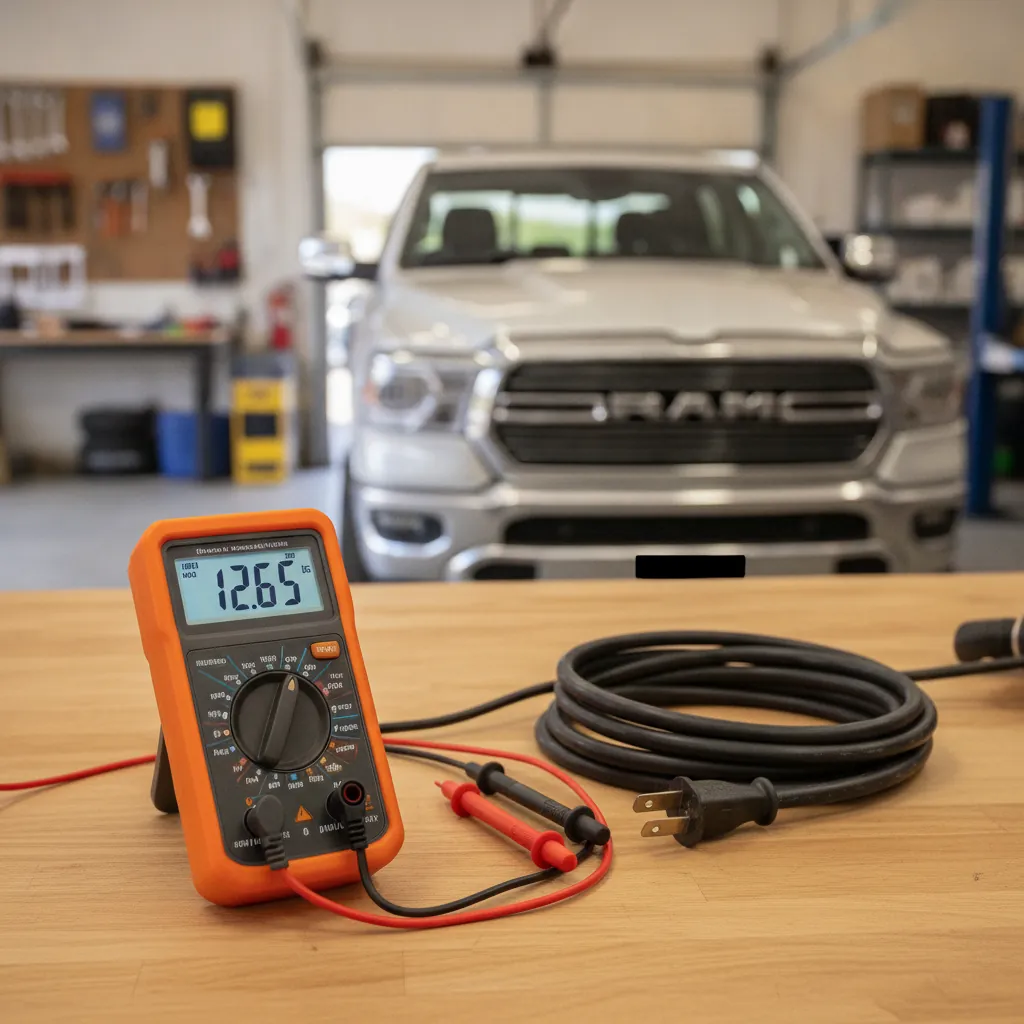
If the outlet is live and the cord is intact, the element in the block is the remaining suspect. This is the check a shop actually does, and it is a resistance test rather than a guess.
With the truck unplugged from the wall, a technician disconnects the cord at the block and measures resistance across the element terminals with a meter set to ohms. What they are looking for is whether the circuit is complete at all. A failed element typically reads open, meaning infinite resistance and no continuity, because the heating wire inside it has burned through. A working element reads a finite, stable resistance.
The specific value it should read varies by engine and by element wattage, so the honest advice is to compare against the figure in the service documentation for your engine rather than a number someone posted online. The pass or fail signal that matters to a truck owner is simpler: open circuit means the element is done.
They will also check the element is not shorted to the block, because an element leaking to ground is exactly what keeps tripping your ground fault breaker even when nothing looks wrong.
Is a Dead Element Worth Replacing?
Here is the honest read, because this is the one repair on the list where the answer is not automatically yes.
Replacing a block heater element is a real job. The element sits in a freeze plug port in the side of the block, and depending on the engine and where that port sits, getting to it can mean removing components to reach it. That is labour, and on some engines it is a lot of labour relative to the size of the part.
It is usually worth doing if you park outside, you are in and out of the truck on short trips all winter, you have a diesel, or the truck is one you plan to keep. The Natural Resources Canada figures above are the argument: at minus 20 a block heater can improve overall fuel economy by as much as 10 percent, and on a single short trip at minus 25 the saving could be around 25 percent. That is before you count the wear you avoid on cold starts, which is the part that does not show up on a fuel bill but shows up on a compression test years later.
It may not be worth doing if the truck lives in a heated garage, the labour to reach the element on your particular engine is steep, and you are looking at the last winter or two of ownership. In that case a good battery, the right oil and a bit more patience on cold mornings is a defensible call.
We will tell you which of those two your truck is in before we start, not after. If it comes down to whether this truck is worth putting money into at all, our service centre can give you the straight version, and if the answer is that you are better off in something newer, our new Ram 1500 inventory is online.
Get the Most Out of the One You Have
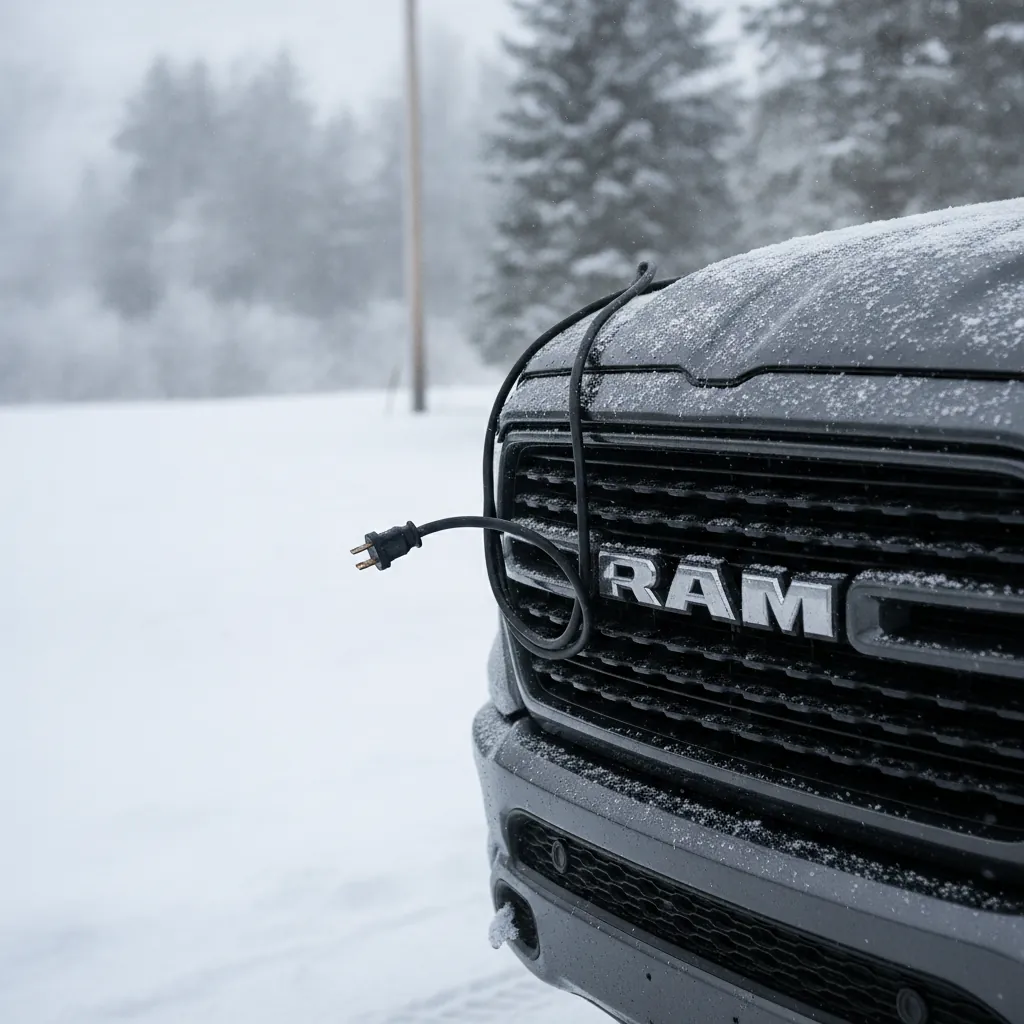
Once it is working, two things get you the full benefit.
Use a timer. Natural Resources Canada recommends an automatic timer that switches the block heater on two hours before you plan to drive, and says that is usually all the time needed to warm the coolant and the engine. Leaving it plugged in all night does not make the engine warmer than the element can make it. It just runs your meter for the extra hours.
Unplug properly. Pull the plug apart by the housings, not by the cord, and do it before you get in. The cords we replace most often were destroyed by being driven away from, and a habit of hanging the truck side end somewhere visible on the grille is what prevents that.
If you want the full picture of how to use one properly and how long it actually needs, we covered that in our Manitoba block heater guide. And if the question underneath all this is whether you should be idling to warm up instead, our post on warming up a diesel in the cold has that answer.
FAQs
How do I know if my block heater is working?
The simplest check is to plug the truck in for two hours on a cold day and then feel the upper radiator hose. A working block heater warms the coolant, and the hose should be noticeably warmer than the surrounding metal. If everything is stone cold after two hours, work through the outlet, the cord and then the element in that order.
Why does my block heater keep tripping the breaker?
That is usually moisture or a fault to ground. Water in the outlet or in a damaged cord will trip a ground fault breaker, and so will a heater element that has failed internally and is leaking to the engine block. If a fresh cord and a dry outlet still trip it, the element is the likely culprit and it needs to be tested.
Can I just replace the block heater cord myself?
Often yes. The cord assembly unplugs from the element and routes through the engine bay, and on many trucks it is a straightforward swap. The part is year and engine specific, so have it matched to your VIN. If the connector at the block is corroded into place or the routing is awkward, it is worth handing off.
What actually fails most, the cord or the element?
In our experience out here it is the cord, by a wide margin. Rodent chew damage, a cracked plug end and corrosion at the block connector are all far more common than a burned out element. That is why the cord inspection comes before any talk of pulling the element.
Is a block heater worth it in Manitoba?
Yes, for most people. Natural Resources Canada reports that at minus 20 a block heater can improve overall fuel economy by as much as 10 percent, and on a single short trip at minus 25 the saving could be in the order of 25 percent. On top of the fuel, it makes the engine easier on itself at start up and gets you heat in the cab faster.
The Bottom Line
A block heater that is not working is almost never a mystery. It is an outlet, a cord or an element, and you can eliminate the first two yourself on a Saturday morning without buying a thing. Do it in that order, because the odds and the cost both run the same direction.
The one piece of advice worth acting on now rather than later is timing. Every shop in this province is full the week of the first hard cold snap, and a block heater is the definition of a thing you want handled before you need it. Book it in while it is still September and we will have it sorted long before it matters.
Tyler Dunn, Dunn Ram Trucks, Portage la Prairie