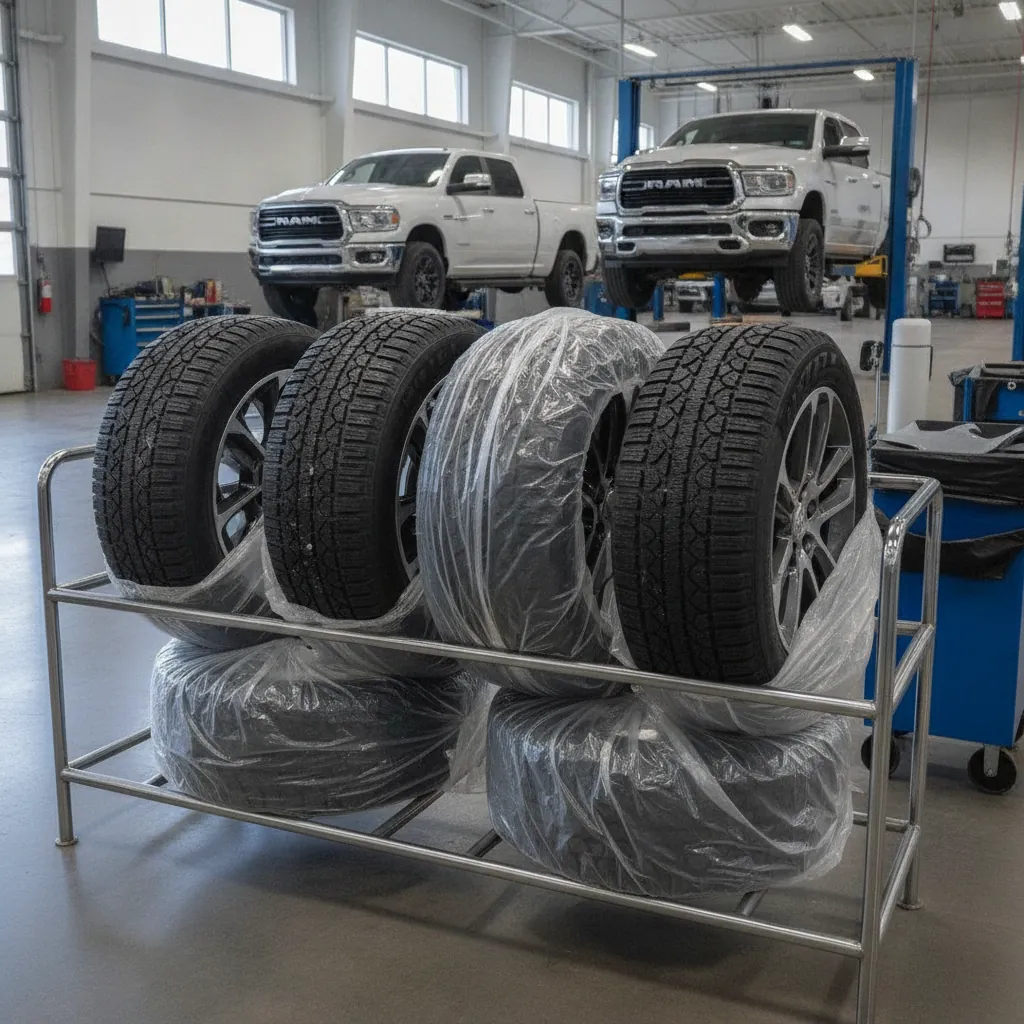
Every spring the same problem shows up in the same order. The snow finally goes, you get your all season tires back on, and then you are standing in the driveway looking at four winter tires on rims wondering where on earth they are supposed to live until October. If you have a garage, they take the corner you wanted for something else. If you live in an apartment in Winnipeg, you genuinely have nowhere to put them. Either way the answer is usually the same one, which is to let the shop that swapped them keep them, and you can book that with our service department at the same time you book the swap.
This is the straight version of what tire storage actually involves, what it does to a tire when you get it wrong, and the one detail about the MPI Winter Tire Program that people find out about a year too late.
Key Takeaways
- Tires are rubber, and rubber ages. Heat, sunlight, ozone and moisture all shorten a tire's life while it is sitting still. Storage is not just a space problem, it is a preservation problem.
- Clean them before they go away. Michelin Canada is explicit: wash off all road salt, grime and brake dust, and make sure the tires are completely dry before storing. Salt sitting on a rim for six months does damage that a wash in October will not undo.
- Mounted tires stack flat. Unmounted tires stand up. Tires still on wheels get stacked horizontally so the weight is shared. Tires off the rim get stood vertically side by side so the sidewalls do not deform.
- Keep them away from your furnace, sump pump and air compressor. Electric motors produce ozone, and ozone attacks rubber. A tire stack beside the furnace is the worst spot in a Manitoba basement.
- The MPI detail worth knowing: the Winter Tire Program will finance storage and the seasonal switchover, but only if those costs are included in the initial purchase. Buy the tires first and try to add storage financing later, and it is no longer covered.
- The 7 degree rule works in both directions. Transport Canada notes that below 7 degrees all season and summer tires begin to lose elasticity. That is your cue in the fall, and above 7 in the spring is your cue to swap back.
Why Storage Is Not Just About Space
Most people think of tire storage as a parking problem. Four tires, one corner, done. The tire itself has an opinion about this.

A tire is a chemical product with a shelf life, and four things shorten that shelf life while it is sitting still. Heat drives the chemistry faster. Ultraviolet light from direct sun breaks down the compound at the surface. Ozone attacks rubber and causes the fine surface cracking you see on old sidewalls. Moisture, especially salty moisture, corrodes the wheel and can work its way into the bead area.
A set of good winter tires is real money, and in Manitoba a set will normally serve you five or six seasons if you look after them. Stored badly they will not, and the failure is quiet. The tire does not look bad. It just stops being as grippy as it was, which you find out on a black ice morning on Highway 1 rather than in your driveway in October.
The shed is the classic Manitoba mistake. An uninsulated shed on a Portage property swings from minus 35 in January to well over plus 40 inside on a July afternoon with the sun on the roof. That annual cycle, repeated over years, is exactly the thing rubber does not want.

How to Store Them Properly If You Are Doing It Yourself
If you have the room and you want to keep them at home, this is the whole method. It is not complicated, it just has to actually be done.
Wash them first. Michelin Canada calls for washing off all road salt, grime and brake dust, then letting the tires dry completely before storage. Do not skip the drying part. A damp tire going into a sealed bag is a mould problem you will meet in the spring.
Bag them individually. Individual tire bags protect against dust and ultraviolet light. Any large heavy bag works. Squeeze the air out and tape it shut.
Stack them the right way for what you have. If the tires are still mounted on wheels, lay them flat and stack them horizontally, which spreads the weight and takes the load off the sidewalls. If they are off the rims, stand them vertically side by side instead, so they do not distort under their own weight.
Pick a cool, dark, dry spot. A basement or an insulated garage is ideal. Direct sunlight and heat sources are what you are avoiding. Somewhere between roughly 10 and 25 degrees is the target, which in practice means inside the heated envelope of your house, not the shed.
Keep them away from anything with an electric motor. This is the one nobody knows. Furnaces, sump pumps and air compressors all generate ozone, and ozone degrades rubber. In a typical Manitoba basement the furnace and the sump pump are the two things you must not stack tires beside.
What the Swap and Store Service Actually Is
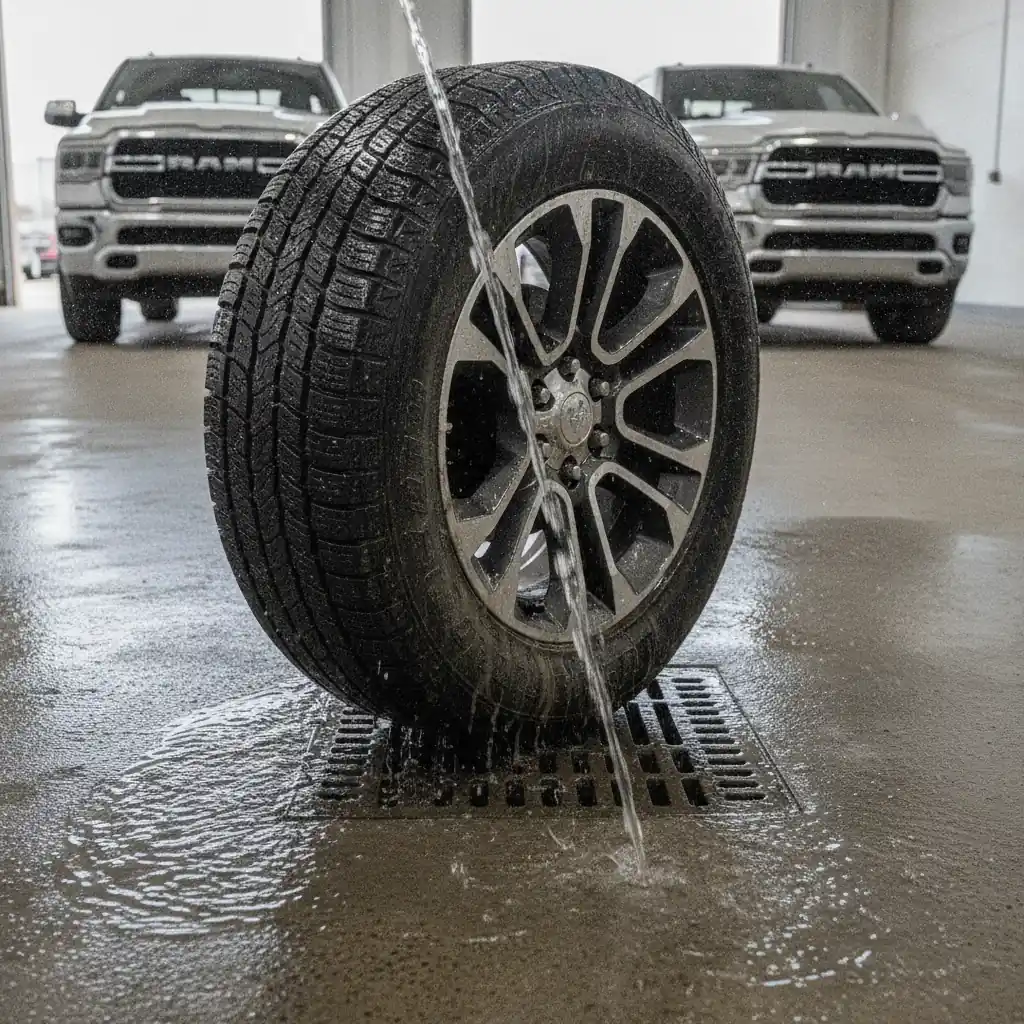
The alternative is to hand the problem to the shop. Around here that service is usually sold as a swap and store, and it bundles three things: the seasonal changeover twice a year, storage of the off season set in between, and an inspection of the set that comes off.
That third part is the one that quietly earns its keep. When your tires come off, someone who looks at tires all day is measuring the tread, checking for uneven wear, looking at the age date and telling you now whether that set has one more winter in it or three. Finding out in April that your winters are done gives you six months to plan the purchase. Finding out in November means buying whatever is in stock during the busiest two weeks of the tire year.
Storage prices vary by shop and by whether the tires are on rims. What you are paying for is the right conditions, the labour on both ends, and not having four tires in the corner of your garage. If you want to know what it runs at our shop for your specific vehicle, ask our service department and we will give you a number rather than a range.
One practical note for anyone in Winnipeg reading this. Storage does not have to be at the shop closest to your house, because you only handle it twice a year. Plenty of our storage customers work in Winnipeg and live in the ring around Portage, and they book the swap for a morning they were coming through anyway.
The MPI Winter Tire Program Detail Most People Miss
This is the part worth the price of admission if you have not bought your winter tires yet.
Manitoba Public Insurance runs a Winter Tire Program that lends eligible customers up to $2,000 per vehicle at prime plus 2 percent, repayable over one to four years. To qualify you have to be an MPI customer as an individual rather than a corporation, own a passenger vehicle or light truck registered in your name, and have no outstanding MPI payments or restrictions against you.
What it covers is broader than most people assume. Beyond the approved winter tires themselves, the loan can cover rims, mounting, balancing and alignment, tire pressure monitoring sensors, studding within limits, nitrogen fill, valve stems and shop supplies, and the applicable taxes and fees.
Here is the catch. Storage and the seasonal switchover are covered only if they are included as part of the initial purchase. MPI is explicit that maintenance and storage are not covered unless they were part of that initial cost, and the same goes for the switchover. So if you buy your winter tires in October and decide the following April that you would like to finance the storage, that ship has sailed for that loan.
The move, then, is to decide about storage at the time you buy the tires, not later. If you know you have no room at home, bundle the storage and the switchover into the original quote and let the program carry it. That is a five minute conversation at the counter that saves real money, and it is exactly the sort of thing our parts department will walk you through before you sign anything. Rates and terms are set by MPI and change, so confirm the current numbers with them or with us before you count on a figure.
When to Swap, in Both Directions
The trigger is temperature, not the calendar, and not whether there is snow on the ground yet.
Transport Canada is clear on the mechanism: below 7 degrees, all season and summer tires begin to lose elasticity, which costs you traction, while winter tires keep their elasticity and grip at much lower temperatures. Transport Canada also recommends installing winter tires in sets of four to keep the vehicle stable, and looking for the peaked mountain with snowflake symbol when you are shopping.
In practice, in Portage and Winnipeg, that puts the fall changeover somewhere in October most years, ahead of the first real cold snap rather than after it. Michelin Canada puts the spring trigger at the same place from the other side: when temperatures consistently rise above 7 degrees, it is time to go back to your summer or all season set.
Book the fall swap early. Every tire shop in this province is buried for two weeks after the first snowfall, and the appointment you take in early October is the one you will actually get on a day that suits you. Our post on when to replace truck tires covers how to tell whether the set going into storage should be coming back out at all, and how often to rotate tires in Manitoba explains why the seasonal swap is also the natural rotation point.

FAQs
How should winter tires be stored over the summer?
Clean off all road salt, grime and brake dust, let them dry completely, then bag each tire individually and put them somewhere cool, dark and dry, ideally between about 10 and 25 degrees. Tires still on wheels get stacked flat and horizontal. Tires off the rim get stood upright side by side. Keep them away from direct sunlight and away from any electric motor, because furnaces, sump pumps and compressors generate ozone that attacks rubber.
Is it bad to store tires in a shed or an unheated garage?
It is not ideal in this climate. An uninsulated shed in Manitoba swings from deep cold in January to well above 40 degrees inside on a hot July afternoon, and repeated temperature extremes plus any sunlight age the rubber faster. A basement or an insulated garage is a much better spot, and a shop storage program is better again.
Does the MPI Winter Tire Program pay for tire storage?
It can, but only if the storage and the seasonal switchover are part of the initial purchase. MPI does not cover maintenance, storage or switchover costs added after the fact. So if you want the program to carry your storage, bundle it into the quote when you buy the tires rather than deciding the following spring.
How much can I borrow under the MPI Winter Tire Program?
Up to $2,000 per vehicle at prime plus 2 percent, repayable over one to four years, for eligible MPI customers on a passenger vehicle or light truck registered in their name. It also covers rims, mounting, balancing, alignment, sensors, studding within limits, and taxes and fees. Confirm current rates and eligibility directly with MPI, since the terms move with the Bank of Canada rate.
Do I need to store winter tires on rims or off?
Either works, and both are stored differently. A second set of rims costs more up front and saves you money and time on every changeover after that, since the shop is only swapping wheels rather than dismounting and remounting rubber twice a year. On rims also stores more predictably, since a mounted tire holds its shape.
When should I put winter tires on in Manitoba?
Go by temperature, not snowfall. Once daily highs are consistently at or below 7 degrees, all season tires start giving up grip. In Portage and Winnipeg that usually lands in October. Book the appointment early, because the two weeks after the first real snow are the busiest of the tire year.
The Bottom Line
Winter tires are a real investment and they last as long as you let them. Wash them, bag them, keep them cool and dark and away from the furnace, and a good set will give you five or six Manitoba winters. Do none of that and you will replace them sooner than you should, without ever quite knowing why.
If you would rather not deal with any of it, that is what a storage program is for. Give us a call or book a service appointment and we will handle the swap, the inspection and the storage, and you can have your garage corner back. And if the set that comes off this spring turns out to be finished, we will tell you that in April when you have time to plan, not in November when you do not.
Tyler Dunn, Dunn Ram Trucks, Portage la Prairie