Search what a truck costs to insure and you will get a national average, a comparison site wanting your email, and a list of private insurers who do not operate here. None of it applies. Manitoba is a public insurance province, which means the basic coverage on your pickup comes from one place, is priced by one published set of rules, and cannot be shopped around the way it can in Alberta or Ontario. That changes what a buyer should actually be doing before they sign, and it is worth knowing before you start pricing trucks in our inventory.
The good news is that a system with published rules is a system you can plan around. The bad news is that a couple of those rules quietly cost people money every year, usually because nobody explained them at the time of purchase. This is the version we give customers across the desk in Portage la Prairie.
One thing up front: we are not going to print a premium figure. We are a truck dealer, not your insurer, and any number we invented would be wrong for your vehicle, your address and your driving record. What we can do is explain exactly which levers set that number, so that when you get a real quote from MPI or an Autopac agent you understand what you are looking at.
Key Takeaways
- Basic Autopac is universal and it is not shoppable. Manitoba Public Insurance provides the basic coverage on every registered vehicle in the province. You choose deductibles and extension coverage, not a carrier.
- MPI names four rating factors on its own rate calculator: the vehicle itself, the territory you are in, the use classification, and your Driver Safety Rating.
- Your vehicle's rate group comes from the CLEAR system. MPI states there are 45 rating groups for cars and light trucks, and "the higher the rating group, the higher the premium." It is built on claim costs and claim risk, not on sticker price.
- Use classification is the one that bites. A pleasure truck cannot be used for business at all, and can only be driven to or from work or school up to four days in one month or 1,609 kilometres in a registration year. Cross those limits and you needed the all purpose class.
- There is a farming class, which matters here more than almost anywhere else in the province. A farming all purpose truck is registered by a person whose primary occupation is farming.
- Driver Safety Rating does the heaviest lifting. MPI's scale runs 41 levels for policies effective April 1, 2026 or later, and the safest drivers see up to 53 percent off their vehicle premiums.
- Get the quote before you commit, not after. Two trucks that look similar on a lot can land in different rate groups.
Manitoba Is Not Like the Rest of Canada
If you have moved here from a private insurance province, the first thing to unlearn is the idea of shopping carriers. Basic Autopac is provided by Manitoba Public Insurance on every vehicle registered in the province. Your agent is a broker for that product, and the basic premium they quote is the basic premium anybody would quote you on the same vehicle, in the same place, with your record.
That is not a bad deal. It means you are not penalized for being new, and it means the price of insuring a specific truck is knowable in advance rather than being a negotiation. It also means the levers you have are different. You cannot switch companies to save money. You can choose your deductible, choose extension coverage, be honest about your use class, and drive in a way that moves you up the safety scale. That is the game.
The Four Things That Set Your Premium
MPI's own rate calculator lists four rating factors. Here is what each one actually means for a pickup.

One: the vehicle. MPI says "your insurance costs are determined, in part, by the claims costs associated with the year, make and model of the vehicle that you drive." Vehicles are sorted using the Canadian Loss Experience Automobile Rating system, better known as CLEAR. MPI states there are 45 rating groups covering cars and light trucks, and the higher the group, the higher the premium.
The part that surprises people is that this is about claims, not price. A vehicle that is safer and cheaper to repair costs less to insure. A vehicle that is less safe or expensive to fix costs more. MPI is explicit that an older, lower value vehicle can land in a similar group to a newer, higher value one if it has fewer safety features and a worse claim history. So do not assume the used truck is automatically the cheaper one to insure. Check.
Because rate group tracks the specific year, make and model, MPI needs the VIN to price it properly. That is why we can give you the VIN off any unit on the lot before you buy, and why we tell people to actually use it.
Two: territory. Manitoba is divided into four territories for rating purposes, and the risk in each one is different. Winnipeg carries the highest traffic density and the highest rates. Rural areas are lower. There is a wrinkle that catches Portage area commuters: MPI charges a commuter rate to Territory 2 drivers who drive into Winnipeg more than four days in a month or more than 1,609 kilometres a year. If you make the drive in regularly, that applies to you, and being straight about it up front is cheaper than the alternative.
Three: use classification. More on this below, because it is the one people get wrong.
Four: Driver Safety Rating. Also below, because it is the one with the biggest swing.
Use Classification: The Rule That Costs People Money
MPI prices your truck partly on what you use it for, and the definitions are specific enough that a lot of owners are quietly in the wrong class.
Pleasure truck. Gross vehicle weight of 4,540 kilograms or less, restricted to pleasure use. MPI states a pleasure vehicle "can't be used for any business purposes." It can be driven to or from work or school up to four days in one month, or not more than 1,609 kilometres to or from work or school in an annual registration period. Driving your kids to school does not count against that.
All purpose truck. Same weight ceiling, but it covers commuting without those limits and permits business use, including the trades and service work that a lot of trucks here actually do.
Farming all purpose truck. MPI defines this as "a truck registered and insured by a person whose primary occupation is farming," with qualifying conditions around hours worked or land farmed. Around Portage this is not a niche category, it is a large share of the pickups on the road.
Fishing all purpose truck. For commercial fishing operations, rated by vehicle weight.
Here is why this matters more than it sounds. If you insure a truck as pleasure and then start using it for the side business, or start commuting in it every day, you are outside the class you paid for. That is not a paperwork problem, it is a coverage problem, and the moment it becomes relevant is the worst possible moment to discover it. The honest move is to describe your real use to your Autopac agent and pay the class that matches. It usually costs less than people fear, and it means the coverage is actually there.
We raise this at the desk more than any other insurance topic, because a truck is the vehicle most likely to drift from personal to business use without anybody consciously deciding it did.
Driver Safety Rating: The Biggest Single Lever
The Driver Safety Rating is the scale that rewards clean driving and penalizes the opposite, and it moves the number more than anything else you control.
MPI states the scale has 41 levels for policies effective April 1, 2026 or later, including a new level +20 at the top. Each year of safe driving with no vehicle claims, driving convictions or suspensions moves you one level up. Convictions, at fault claims, and impaired or distracted driving move you down.
At the top of the scale MPI lists savings of "up to 53 per cent" on vehicle premiums, plus up to an additional $30 off the driver's licence premium. At the bottom, the highest risk drivers pay up to a $3,010 premium on the licence charge and get no vehicle discount at all. That is the full width of the scale, and it dwarfs the difference between two trims of the same truck.
There is a genuinely encouraging detail in there too. MPI notes that a driver with an active licence sitting at level minus 20 moves up seven levels for one year of safe driving. The climb back is faster than the fall, which is not something every system does.
Practical read for a buyer: if your record is clean, you are already getting the best price this province offers, and the vehicle choice is the only lever left. If your record is not clean, that is where the money is, not in the trim you pick.
What To Actually Do Before You Buy a Truck
A short, boring checklist that saves real money.
Get the VIN and get a quote before you sign. Rate group is set by the specific vehicle. Two pickups sitting side by side on our lot, similar money, can land differently. Ask us for the VIN, take it to your Autopac agent or the MPI rate calculator, and get the actual number. We would far rather you did this before the paperwork than after.
Be honest about use, and about the commute. Pleasure looks cheaper right up until it does not apply. If you commute to Winnipeg regularly, that commuter threshold applies. If the truck ever works, it is not a pleasure truck.
Pick your deductible deliberately. A higher deductible lowers the premium and raises what you pay when something happens. On a truck that lives on gravel, think about how often small damage actually occurs before you take the cheapest option.
Know where the glass and body work go. Windshield damage is close to a fact of life on prairie gravel. We handle MPI glass repair right here in Portage la Prairie, which is one less trip to Winnipeg when a stone finds you.
Budget insurance alongside the payment, not after it. People shop trucks on the monthly payment and then get surprised. If you are working out what fits, our financing application is a starting point, and our post on how much truck you can afford in Manitoba walks the whole cost picture rather than the payment alone.
If you are trading, know that number first too. Our instant cash offer will tell you where your current vehicle sits before you fall in love with the next one.
New Truck or Used Truck: Which Insures Better?
There is no universal answer, which is exactly the point of the CLEAR system.
A newer truck usually carries more standard safety equipment, and MPI is clear that safety features can lower costs. It also costs more to repair, which pushes the other way. An older truck is cheaper to replace but may have a worse claim history and fewer safety systems, and MPI explicitly warns that a lower value older vehicle can rate similarly to a newer one.
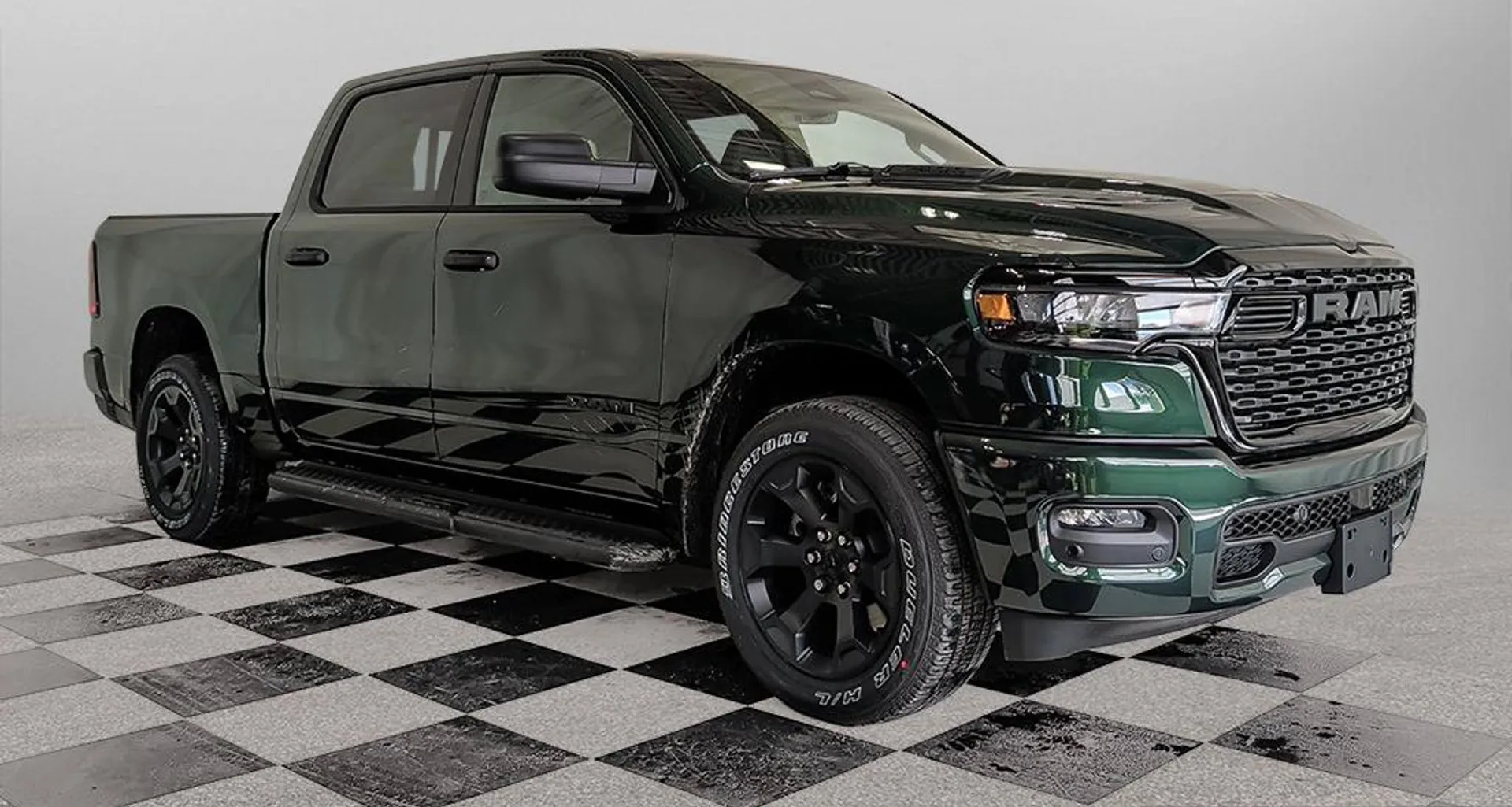
The result is that you cannot reason your way to the answer. You have to check the specific vehicles. If you are weighing the two, our post on buying new versus used covers the rest of the tradeoff, and both our new Ram 1500 inventory and our used inventory list what is actually here right now with VINs we can hand you.
FAQs
How much does it cost to insure a truck in Manitoba?
There is no single figure, because Basic Autopac prices each vehicle from your specific combination of rate group, territory, use classification and Driver Safety Rating. Anyone quoting you an average is guessing. Get the VIN of the truck you are considering and run it through MPI or an Autopac agent before you buy. We will hand you the VIN on any unit on our lot for exactly that reason.
Can I shop around for truck insurance in Manitoba?
Not for the basic coverage. Manitoba Public Insurance provides Basic Autopac on every vehicle registered in the province, so the basic premium is the same regardless of which agent writes it. What you can choose is your deductible level and any extension coverage on top of the basic policy.
What is a vehicle rate group and how is mine set?
MPI sorts vehicles using the CLEAR system, which groups vehicles with similar claim costs and claim risks together. MPI states there are 45 rating groups for cars and light trucks, and the higher the group, the higher the premium. It reflects safety, repair cost and claim history rather than the price of the vehicle, which is why an older truck is not automatically cheaper to insure.
What is the difference between pleasure and all purpose use on a truck?
MPI states a pleasure vehicle cannot be used for any business purpose, and can be driven to or from work or school only up to four days in one month or 1,609 kilometres in a registration year. An all purpose truck covers unrestricted commuting and business use. If your truck works, or you commute in it daily, it is an all purpose truck and insuring it as pleasure leaves you outside your coverage.
Is there a farm rate for trucks in Manitoba?
Yes. MPI defines a farming all purpose truck as one registered and insured by a person whose primary occupation is farming, with qualifying conditions tied to hours worked or land farmed. Talk to your Autopac agent about whether your operation qualifies, since it is a real category and not a courtesy discount.
How much can Driver Safety Rating save me?
A lot. MPI's scale runs 41 levels for policies effective April 1, 2026 or later, and drivers at the top see up to 53 percent off their vehicle premiums plus up to $30 off the driver's licence premium. The highest risk drivers get no vehicle discount and can pay up to a $3,010 licence premium. It is the largest single lever most drivers have.
The Bottom Line
Manitoba's system is unusual, and unusual is not the same as bad. Because the rules are published, a truck buyer here can know the insurance cost before committing instead of after, which is more than most provinces offer.
Do three things. Get the VIN and get a real quote before you sign. Insure the truck for the way you actually use it, especially if it ever works or commutes. Protect your Driver Safety Rating, because nothing else on the list moves the number as far.
Then come see us. Walk our inventory, pick the trucks you are serious about, and we will give you the VINs so you can price the whole cost of owning them, not just the payment. That is the only comparison worth making.
Tyler Dunn, Dunn Ram Trucks, Portage la Prairie